




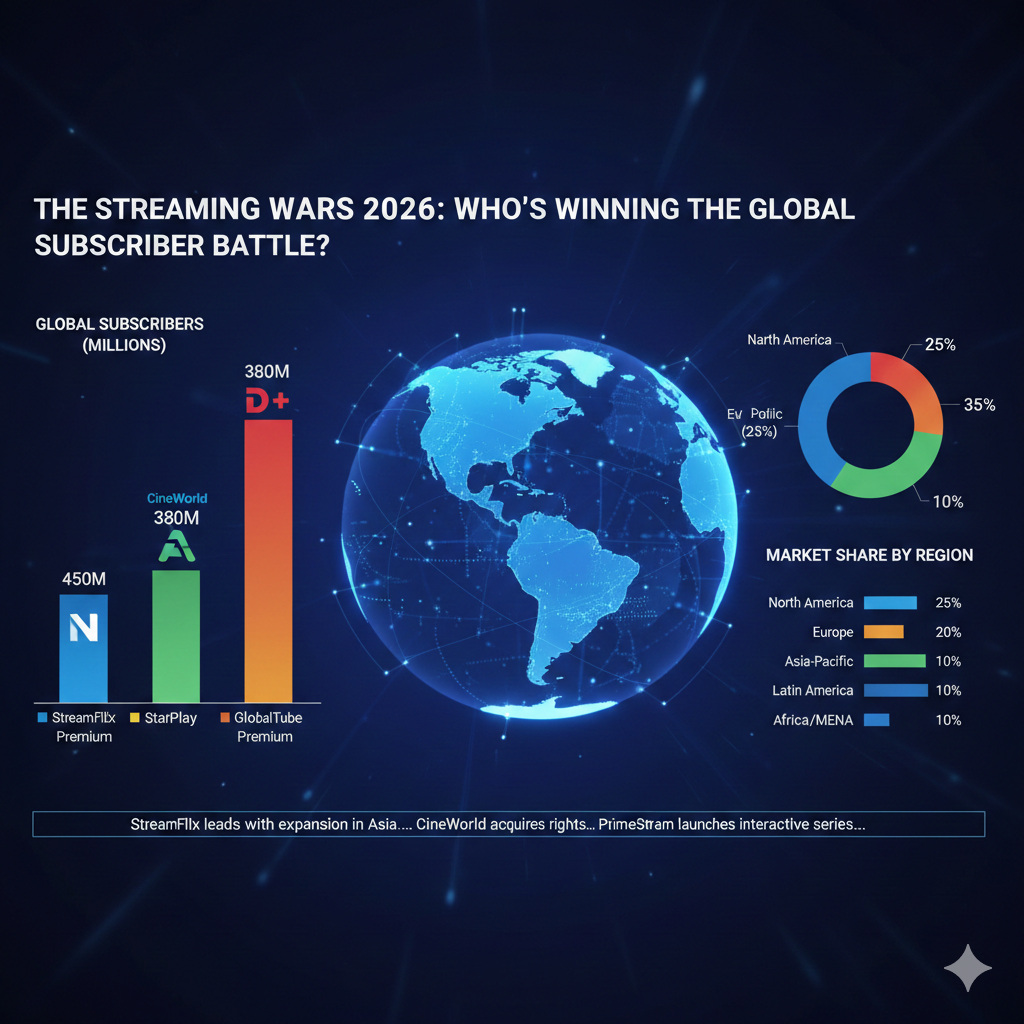
The landscape of home entertainment has undergone a radical transformation over the last decade. What began as a novel way to rent movies by mail has evolved into a global economic battleground involving the world’s largest technology and media conglomerates. By 2026, the “streaming wars” are no longer about land grabs and unchecked spending; they have matured into a complex contest of profitability, retention, and technological dominance.
For consumers, the era of infinite choice has arrived, but it brings with it the fatigue of fragmentation. For the platforms themselves—giants like Netflix, Disney, Amazon, and Warner Bros. Discovery—the stakes have never been higher. The initial rush to accumulate subscribers at any cost has been replaced by a disciplined focus on average revenue per user (ARPU), ad-tier monetization, and strategic consolidation.
This analysis explores the state of the streaming industry in 2026, dissecting the strategies that are working, the regions driving growth, and the technological innovations defining the next generation of entertainment consumption.
What Are the Streaming Wars?
The term “streaming wars” refers to the intense competition between video-on-demand services to capture consumer time and subscription dollars. This phenomenon fundamentally disrupted the traditional cable and satellite television model, known as linear TV.
Historically, viewers were tethered to set schedules and expensive hardware bundles. The digital revolution unbundled content, allowing users to pay for specific libraries of movies and television shows delivered over the internet. While early movers enjoyed a monopoly on attention, the entry of legacy media studios and tech titans created a fragmented market.
By 2026, the definition of this “war” has shifted. It is no longer strictly a battle of subscriber counts. It is a battle for the ecosystem. Companies are not just selling video; they are selling integrated lifestyles that include gaming, merchandise, and live experiences, all anchored by their streaming platforms. The shift from cable to digital is largely complete in many developed markets, making the fight for the remaining market share aggressive and highly calculated.
Why 2026 Is a Critical Year for Streaming Competition
The year 2026 marks a pivotal turning point for the industry. For the first half of the 2020s, investors rewarded subscriber growth above all else. Platforms burned through billions of dollars to produce original content, often operating at a loss to secure market share.
However, the economic reality has reset the board. Shareholders now demand sustainable profit margins. This shift has forced streaming services to pivot from “growth at all costs” to “smart growth.”
Subscriber Growth vs Profitability
The tension between adding new users and making money from existing ones is the central theme of 2026. In mature markets like North America and Western Europe, penetration rates are high. Most households that want streaming already have it. Consequently, growth strategies have shifted toward increasing the value of each subscriber through price hikes, cracking down on password sharing, and pushing users toward high-margin ad-supported tiers.
Global Expansion Strategies
With Western markets nearing saturation, the battleground has moved. 2026 is the year where aggressive expansion into India, Southeast Asia, Africa, and Latin America is distinguishing the winners from the losers. These regions offer massive population bases, but they also present challenges regarding lower disposable income and diverse cultural content preferences. Success in 2026 depends on a platform’s ability to monetize these lower-ARPU regions efficiently.
Major Players in the Global Streaming Battle
The ecosystem has stratified into three distinct categories of competitors, each employing different tactics to secure their footing.
Subscription-Based Platforms
The heavyweights—Netflix, Disney+, and Max (Warner Bros. Discovery)—continue to dominate the premium subscription video on demand (SVOD) space. Their primary weapon remains massive content investment. By 2026, these platforms function as global utility services for entertainment. They rely on vast libraries of intellectual property (IP) and franchise management to keep churn low. Their global reach allows them to amortize the cost of a blockbuster series across hundreds of millions of viewers worldwide.
Ad-Supported Streaming Models
Advertising video on demand (AVOD) and free ad-supported streaming TV (FAST) have exploded in popularity. Services like Tubi, Pluto TV, and the ad-tiers of premium services like Netflix and Disney+ are now significant revenue drivers.
In 2026, the hybrid model is the standard. Pure subscription models are becoming a luxury niche. Most consumers are opting for lower-priced (or free) tiers in exchange for watching commercials, mirroring the television model of the 20th century but with better targeting and data analytics.
Regional Streaming Services
While global giants get the headlines, regional players are holding their ground. Platforms like Viu in Southeast Asia, Canal+ in parts of Europe, and localized services in India have successfully defended their turf by offering hyper-local content that Hollywood struggles to replicate. These services understand local nuances, language dialects, and cultural touchstones, proving that a one-size-fits-all global strategy has limitations.
Key Factors Determining Who’s Winning
Identifying a “winner” in 2026 requires looking beyond the headline subscriber number. Several metrics now paint a more accurate picture of health and longevity.
Subscriber Numbers vs Engagement
A subscriber who pays but never watches is a high churn risk. Platforms are increasingly optimizing for “time spent” and “daily active users.” Engagement metrics determine the stickiness of a service. If a user logs in daily, they are less likely to cancel. The winners in 2026 are those who have successfully integrated their apps into the daily habits of their users, often through a mix of news, sports, and comfort viewing.
Content Libraries and Exclusive Shows
The depth of a library matters as much as the new releases. While a hit show drives sign-ups (acquisition), a deep library of sitcoms, documentaries, and movies drives retention. Platforms with back catalogs of 20+ seasons of popular procedural dramas or sitcoms have a distinct advantage in retaining users during the gaps between major blockbuster releases.
Pricing and Bundling Strategies
The standalone subscription is becoming an endangered species. The winning strategy in 2026 involves bundling. Whether it is hard bundles (Disney+, Hulu, and ESPN+) or soft bundles via telecom operators (getting a streaming service free with a 5G data plan), the goal is to make the service indispensable and difficult to cancel.
Role of Original Content in Subscriber Growth
Original content remains the primary differentiator in a crowded market. However, the strategy for creating originals has evolved.
Blockbuster Series and Franchises
High-budget fantasy and sci-fi series serve as the tentpoles of streaming services. These productions, often costing upwards of $20 million per episode, are designed to create cultural moments that drive massive influxes of new subscribers. In 2026, relying on established IP (spinoffs, prequels, and sequels) is the safest bet for ensuring a return on investment.
Localization of Content
Perhaps the most significant shift is the globalization of production. Following the success of Korean dramas and Spanish thrillers in the early 2020s, US-based platforms are heavily investing in local productions in Germany, Japan, Brazil, and Nigeria. This “local-for-global” strategy serves a dual purpose: it captures the local market while providing exotic, dubbed, or subtitled content for international audiences, filling the content pipeline at a lower cost than Hollywood productions.
Streaming Pricing Wars and Bundling Trends
As consumers grew weary of managing six or seven different subscriptions, the industry responded with aggregation.
Tiered Subscriptions
Flexibility is key. Most major platforms now offer three or four tiers: Mobile-only (for emerging markets), Basic with Ads, Standard (Ad-free), and Premium (4K/Dolby Atmos). This tiering allows companies to capture price-sensitive customers without devaluing their premium product.
Partnerships with Telecom Providers
Telcos have become the new cable companies. In 2026, a significant percentage of streaming subscriptions are managed through mobile phone or home internet bills. These partnerships reduce customer acquisition costs for streaming services and reduce churn, as customers are less likely to cancel a service that is “baked in” to their utility bill.
Impact of Sports and Live Events on Streaming Platforms
Live sports was the final firewall protecting traditional cable TV. By 2026, that wall has been breached.
Exclusive Broadcasting Rights
Tech giants have outbid traditional networks for rights to major sporting leagues. Whether it is football, soccer, cricket, or Formula 1, premium sporting events are now anchored on streaming platforms. This shift is strategic; sports fans are loyal and watch live, which is crucial for advertisers.
Real-Time Audience Engagement
Streaming offers interactive features that linear TV never could. In 2026, watching a game on a streaming platform often includes real-time stats overlays, alternative camera angles, and integrated betting options. This interactivity increases engagement time and opens new revenue streams for the platforms.
Global Expansion and Emerging Markets
The saturation of the US market means that the next billion subscribers must come from elsewhere.
Asia-Pacific and Latin America Growth
The Asia-Pacific (APAC) region acts as the primary engine for subscriber growth. High mobile penetration and a young demographic make it fertile ground. However, the Average Revenue Per User (ARPU) in these regions is significantly lower than in the US. The challenge for global players is to scale operations efficiently so that the volume of subscribers offsets the lower price point.
Language and Cultural Adaptation
Dubbing and subtitling are no longer afterthoughts; they are central to product development. AI-driven dubbing technology has improved by 2026, allowing for near-instantaneous translation of content into dozens of languages, making global day-and-date releases seamless.
Challenges Facing Streaming Companies
Despite the growth, significant headwinds remain.
Content Costs and Profitability Pressure
Creating premium content is expensive, and production costs continue to rise. Balancing the checkbook while trying to produce “HBO-quality” drama is a constant struggle. Platforms are canceling shows faster than ever if they do not perform immediately, leading to friction with talent and frustration among fans.
Subscriber Churn and Market Saturation
“Service hopping”—signing up for a month to binge a show and then canceling—is a behavior platforms are fighting to stop. With so many options available, consumer loyalty is thin. Combating churn requires constant engagement and algorithmic precision to surface the right content at the right time.
Technology Shaping the Future of Streaming
Technology is the silent weapon in the streaming wars.
AI Recommendations
By 2026, recommendation engines have moved beyond “Because you watched X.” AI now analyzes viewing habits, time of day, and even pacing preferences to curate highly personalized feeds. This reduces the “doom scrolling” phenomenon where users spend more time searching than watching.
Personalized Viewing Experiences
We are seeing the early stages of personalized content delivery, where trailers and thumbnails are dynamically generated to appeal to specific users. If a user watches romantic comedies, the thumbnail for an action movie might feature the romantic subplot rather than the explosions.
Cable TV vs Streaming in 2026
The relationship between traditional TV and streaming has settled into a predictable decline for the former.
Decline of Traditional TV
Linear TV has not disappeared, but it has diminished. It primarily serves an older demographic and specific live news functions. The “cord-cutting” trend has stabilized simply because most of the cords have already been cut.
Rise of Multi-Platform Viewing Habits
Viewers in 2026 are platform agnostic. They move seamlessly between a smart TV app, a mobile phone on the commute, and a tablet in bed. The winning platforms are those that provide a flawless, synchronized experience across all devices.
Future Outlook: Will the Streaming Wars Slow Down?
The intensity of the competition is unlikely to wane, but the nature of the fight will change.
Consolidation and Mergers
The market cannot support dozens of standalone apps. We are entering a phase of consolidation where mid-sized players merge or are acquired by larger tech or media ecosystems. The future likely holds a “Big Three” or “Big Four” scenario, similar to the mobile carrier market.
New Business Models Emerging
Streaming services are evolving into “super apps.” We can expect to see further integration of video games, e-commerce (shopping for items seen on screen), and social viewing experiences. The goal is to keep the user within the ecosystem for as long as possible, monetizing every minute of their attention.
FAQs – Streaming Wars 2026
Which streaming platforms are growing fastest?
While Netflix retains the lead in total numbers, platforms focusing on emerging markets like India and Southeast Asia are seeing the fastest percentage growth rates. Additionally, ad-supported tiers are growing faster than premium ad-free tiers across the board.
Are streaming services still gaining subscribers?
Yes, but the rate of growth has slowed significantly in developed markets. Most net new additions are coming from developing nations or from households switching from cable to streaming.
How important is original content in the streaming battle?
It is critical for acquisition. Exclusive original content is the primary driver that convinces a user to sign up for a new service. However, deep libraries of licensed content are what keep them subscribed.
Will streaming replace traditional TV completely?
Not completely, but it will become the dominant form of distribution. Traditional TV will likely persist as a niche for live news and specific demographics, but streaming is the default for entertainment.
Are ad-supported plans becoming the norm?
Yes. Price sensitivity among consumers and the desire for revenue diversification among platforms have made hybrid ad-supported plans the standard offering for the majority of new sign-ups.
The Final Verdict
The streaming wars of 2026 are a battle of efficiency, technology, and global scale. The days of reckless spending are over. The winners will be the platforms that can balance the high cost of premium content with the technical agility to deliver it profitably to a global audience. For the consumer, the golden age of content continues, but the price of admission is complexity. As the dust settles, it is clear that streaming is not just the future of television—it is television.


