




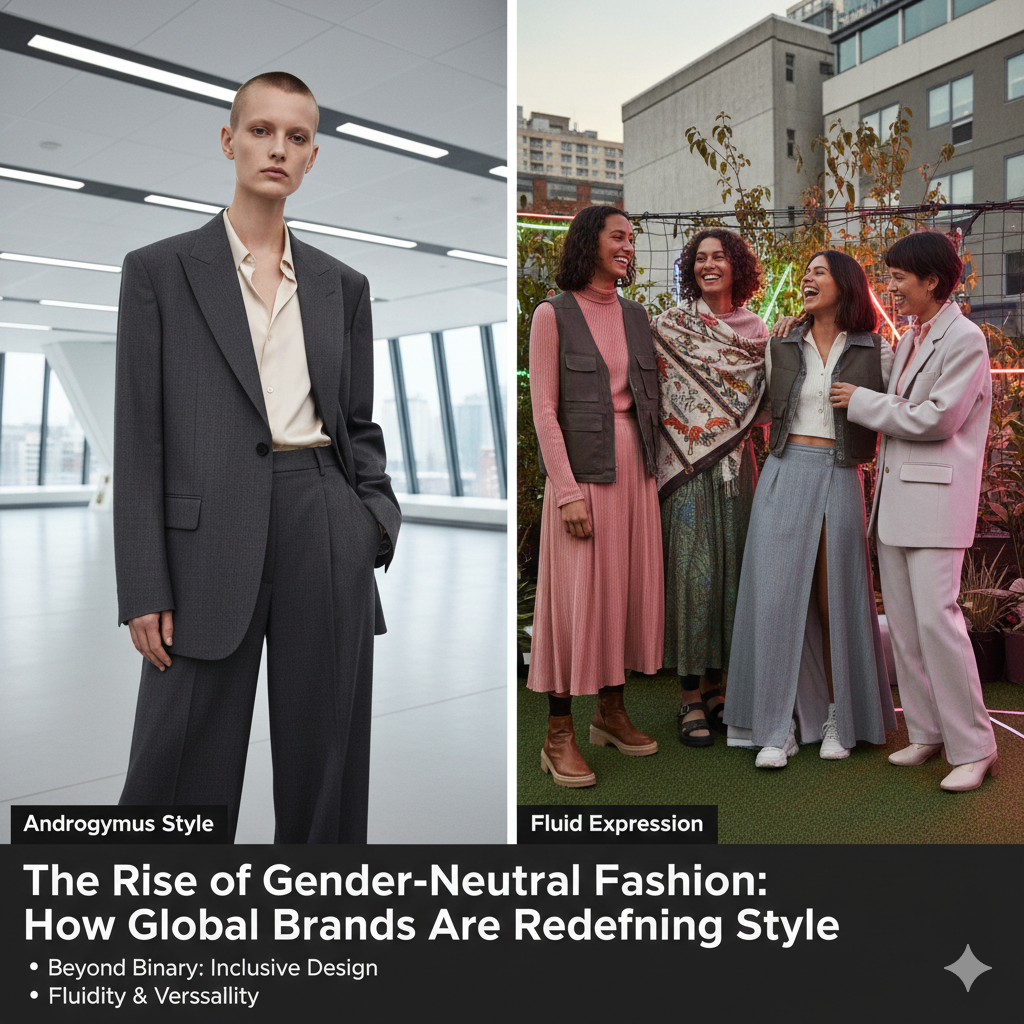
Fashion has historically served as a rigid marker of identity, drawing clear lines between “menswear” and “womenswear.” Walk into almost any department store from the last century, and you would find the layout strictly divided: suits and rugged fabrics on one side, dresses and delicate prints on the other. This binary approach dictated not just how people shopped, but how they were expected to present themselves to the world.
However, the global fashion landscape is undergoing a seismic shift. The boundaries that once defined clothing categories are blurring, driven by a cultural movement that prioritizes inclusivity and individual expression over traditional norms. We are witnessing the mainstreaming of gender-neutral fashion—a philosophy that disconnects clothing from gender entirely.
This movement is not merely a fleeting trend or a niche subculture. It represents a fundamental restructuring of the industry, influencing everything from design sketches and sizing charts to marketing campaigns and store layouts. As consumers increasingly reject labels that limit their self-expression, global brands are responding by rethinking what it means to dress the modern individual. This article explores the forces driving this transformation, the challenges brands face in adapting, and what the future holds for a fashion industry moving beyond the binary.
What Is Gender-Neutral Fashion?
At its core, gender-neutral fashion refers to clothing designed without a specific gender in mind. It moves beyond the idea that certain cuts, colors, or fabrics belong exclusively to men or women. Instead, it focuses on the garment itself—its fit, functionality, and aesthetic appeal—allowing the wearer to define how it fits into their identity.
The concept is often confused with “unisex” clothing, but there is a nuance. Historically, unisex collections were often just men’s basics—t-shirts, hoodies, and jeans—sized down for women. They prioritized utility but often lacked style or tailored fit. Gender-neutral fashion, by contrast, is more design-forward. It involves intentional pattern-making that accommodates diverse body types without defaulting to a boxy, shapeless silhouette. It embraces skirts, tunics, vibrant colors, and intricate textures for all bodies, not just modifying menswear for the masses.
“Gender-fluid” fashion is another related term, often describing a style that shifts and flows between masculine and feminine aesthetics. While gender-fluid refers to the wearer’s expression, gender-neutral refers to the product itself. The ultimate goal of this category is fluidity: a wardrobe where a piece of clothing is simply a piece of clothing, free from the societal baggage of who “should” wear it.
Why Gender-Neutral Fashion Is Rising Globally
The driving force behind this shift is cultural rather than commercial. Society is currently navigating a broad re-evaluation of gender roles. As conversations about inclusivity and equality gain traction globally, the rigid structures of the past are being dismantled. Fashion, as a reflection of culture, is naturally mirroring these changes.
Consumers are increasingly viewing their identity as a spectrum rather than a fixed point. This is particularly visible in how people choose to dress. The desire for authenticity has superseded the need to conform to traditional expectations. A suit is no longer a symbol of masculine power, just as the color pink is no longer the sole domain of femininity. People are dressing to reflect their mood, their taste, and their comfort, disregarding the “men’s” or “women’s” label on the hangtag.
This shift is also practical. Modern lifestyles often demand versatility. Clothing that offers freedom of movement and comfort tends to align with gender-neutral principles. The rise of remote work and the casualization of everyday dress have accelerated this, making strict sartorial codes feel increasingly obsolete.
How Global Brands Are Redefining Style
Major fashion houses and high-street retailers are recognizing that sticking to a binary model limits their relevance. To stay competitive, they are overhauling their strategies across design, marketing, and retail.
Inclusive Design Philosophy
The most significant change is happening on the drawing board. Designers are rethinking the “block”—the basic template used to size garments. Traditionally, brands used two distinct blocks: one for the male physique (broader shoulders, narrower hips) and one for the female physique (narrower shoulders, wider hips, bust allowance).
Gender-neutral design requires a hybrid approach. It involves creating silhouettes that can flatter a wider range of anatomies. This often results in dropped shoulders, adjustable waistbands, and fabrics with more drape or stretch. Sizing systems are also being overhauled. Instead of the standard S-M-L based on gendered averages, some brands are moving toward measurement-based sizing or finding a “median” fit that works across the board. The aesthetic is shifting too, with versatility taking center stage. A single jacket is now designed to look structured on one body type and oversized on another, with both looks being intentional rather than accidental.
Marketing Without Gender Labels
Marketing campaigns are abandoning the “boy meets girl” narratives that dominated advertising for decades. Instead, brands are focusing on individuality and community. You see campaigns featuring a diverse cast of models wearing the same collection in different ways, highlighting personal style over gendered expectations.
Language plays a crucial role here. Product descriptions are becoming more objective, focusing on the cut, fabric, and fit rather than who the item is for. Keywords like “menswear” and “womenswear” are disappearing from landing pages in favor of categories like “outerwear,” “tops,” and “accessories.” This linguistic shift signals to the consumer that they are welcome to shop the entire catalog, not just half of it.
Retail and Merchandising Changes
The physical shopping experience is the final frontier for this transformation. Historically, store layouts were strictly segregated, often on different floors. This forced shoppers to physically cross a divide if they wanted to explore items outside their assigned gender section—a social friction that discouraged experimentation.
Forward-thinking retailers are now experimenting with “degendered” retail spaces. These stores organize clothing by category (e.g., denim, knitwear, formal) or by aesthetic (e.g., minimalist, streetwear) rather than by gender. This encourages shoppers to browse freely and discover items they might have otherwise ignored. Online, this translates to navigation menus that allow users to filter by “style” or “fit” rather than clicking strictly “Men” or “Women” upon entry.
Influence of Gen Z and Younger Consumers
While cultural shifts affect everyone, the adoption of gender-neutral fashion is most rapid among Generation Z. For this demographic, gender is often viewed as a social construct rather than a biological imperative. They are the most racially and ethnically diverse generation in history, and they demand inclusivity in every aspect of their lives, including the brands they support.
For younger consumers, fashion is a primary tool for identity experimentation. They are less likely to buy a brand simply because it is famous; they buy into brands that align with their values. If a brand enforces rigid gender stereotypes, it risks alienating this crucial market segment.
Social media platforms like TikTok and Instagram act as accelerants for this trend. Trends like the “soft boy” aesthetic or women embracing “dad core” style spread virally, normalizing cross-gender dressing. Influencers and content creators routinely mix and match items from all departments, showing their followers that style has no gender. This user-generated content validates the gender-neutral approach far faster than any corporate marketing campaign could.
Role of Streetwear and Minimalism in Gender-Neutral Style
Two specific aesthetics have paved the way for the gender-neutral movement: streetwear and minimalism.
Streetwear, with its roots in skate and hip-hop culture, has always prioritized oversized fits. Hoodies, sneakers, and baggy tees are inherently less gendered than tailored suits or evening gowns. As streetwear became the dominant trend of the last decade, it trained the consumer eye to appreciate voluminous silhouettes that obscure the body’s shape rather than accentuating it. This naturally lends itself to gender-neutral design, as the “fit” is intentionally loose.
Minimalism operates on a similar principle but through aesthetics rather than fit. The minimalist movement relies on neutral palettes—blacks, whites, beiges, grays—and clean lines. By stripping away gendered signifiers like excessive ruffles, lace, or aggressive macho detailing, minimalism creates a blank canvas. A simple beige trench coat or a crisp white button-down shirt is a staple that belongs to everyone. These styles provided a safe entry point for the mass market to begin engaging with gender-neutral concepts without feeling like they were making a radical political statement.
Benefits of Gender-Neutral Fashion for Brands
While the shift is consumer-driven, the business case for gender-neutral fashion is compelling.
Expanded Audiences: By removing gender labels, brands effectively double the potential audience for every garment. A sweater designed for “men” is only marketed to 50% of the population. A gender-neutral sweater is marketed to 100%.
Simplified Product Lines: Producing separate collections requires developing separate patterns, sourcing different fabrics, and managing distinct inventory streams. A unified collection streamlines the supply chain. Brands can produce fewer unique SKUs (Stock Keeping Units) while maintaining depth in their inventory. This efficiency is particularly attractive in a volatile economic climate where inventory management is critical.
Reduced Markdown Risk: When a product isn’t tied to a specific gender trend, it often has a longer shelf life. A classic, gender-neutral hoodie is less likely to go out of style than a gender-specific item heavily influenced by seasonal fads. This stability can lead to fewer markdowns and healthier margins.
Challenges Facing Gender-Neutral Fashion
Despite the progress, the road to a fully gender-inclusive industry is fraught with logistical and cultural hurdles.
Fit and Sizing Complexities: The biological reality is that bodies are different. Designing a single pair of jeans that fits a 6’2″ man with narrow hips and a 5’4″ woman with wider hips is technically difficult. Brands risk creating clothing that fits no one well in an attempt to fit everyone. The “one size fits all” approach rarely works in fashion, and developing a truly inclusive sizing chart requires significant R&D investment.
Traditional Retail Expectations: While Gen Z is on board, older generations often find gender-neutral shopping confusing or uncomfortable. Many consumers still prefer the guidance of gendered sections. Retailers face the challenge of educating these customers without alienating them. Furthermore, department stores and wholesale partners often still operate on binary buying systems, making it difficult for gender-neutral brands to find a place on the sales floor.
The “Boring” Trap: Critics argue that in an effort to appeal to everyone, gender-neutral fashion often defaults to basics—sweats, tees, and shapeless sacks in drab colors. The challenge for designers is to bring excitement, sexiness, and avant-garde creativity to the category, proving that genderless clothing doesn’t have to mean generic clothing.
Impact on Fashion Industry Trends
The ripple effects of this movement are visible at the highest levels of the industry. Runway shows, once strictly divided into Men’s Fashion Week and Women’s Fashion Week, are increasingly combining. Major luxury houses are presenting co-ed shows, acknowledging that their customers shop across lines anyway.
Collaborations are also shifting. We are seeing more partnerships between heritage brands and queer artists or gender-fluid creators. These collaborations inject fresh perspectives into established houses, pushing them to experiment with cuts and colors they historically avoided. This cross-pollination is accelerating the acceptance of skirts for men, structured suiting for women, and accessories like pearls and handbags becoming universal.
Sustainability and Gender-Neutral Design
Sustainability is often cited as a partner to the gender-neutral movement, and there is validity to this claim.
Longer Garment Lifespan: Gender-neutral clothing is often designed with durability and timelessness in mind. Because it relies less on gendered micro-trends (like the “cold shoulder” top or “muscle fit” shirts), the clothing tends to remain wearable for longer periods.
Shared Wardrobes: The rise of gender-neutral fashion encourages the sharing of clothes between partners, friends, or family members regardless of gender. This effectively increases the utilization rate of each garment, which is a key metric in sustainable fashion.
Capsule Wardrobe Influence: The movement aligns perfectly with the capsule wardrobe philosophy—owning fewer, better items that mix and match. A gender-neutral blazer can be styled in dozens of ways for different occasions, reducing the perceived need for a massive closet.
However, a balanced perspective is necessary. Simply labeling a t-shirt “gender-neutral” does not make it sustainable if it is mass-produced from cheap synthetics and shipped globally. Greenwashing remains a risk, where brands use the “inclusive” label to sell more fast fashion without addressing the underlying environmental cost of production.
Future of Gender-Neutral Fashion
As we look ahead, gender-neutral fashion appears poised to transition from a “trend” to a standard industry category.
We can expect to see advancements in digital fashion and customization play a huge role. Digital tailoring technologies could allow customers to order gender-neutral designs that are then custom-fitted to their unique measurements, solving the fit problem. In the metaverse and digital gaming spaces, where physical limitations don’t exist, gender-neutral skins and avatars are already the norm, training the next generation of consumers to view identity as fluid.
Mainstream adoption will likely continue to grow across markets. While currently concentrated in urban centers and Western markets, the demand for inclusive sizing and styling is global. As major retailers continue to integrate these collections, the shock value will diminish, and walking into a store organized by “color” or “mood” rather than “men” and “women” will simply feel like the new normal.
The future of fashion is not about erasing gender; it is about erasing the limitations placed upon it. It is about giving the consumer the autonomy to decide what suits them best, without the industry dictating the terms.
FAQs – Gender-Neutral Fashion
What does gender-neutral fashion mean?
Gender-neutral fashion refers to clothing and accessories designed without a specific gender in mind. It avoids traditional “menswear” or “womenswear” labels, focusing instead on fit, style, and functionality that can be worn by anyone regardless of their gender identity.
Is gender-neutral fashion the same as unisex?
Not exactly. While both are intended for all genders, “unisex” traditionally refers to basic garments (like t-shirts and jeans) sized for men but marketed to everyone. Gender-neutral fashion is a broader, more design-led category that includes skirts, dresses, and tailored pieces, often featuring sizing systems reimagined to fit diverse body types better than standard unisex items.
Why are brands adopting gender-inclusive designs?
Brands are adopting these designs to align with changing cultural values regarding inclusivity and identity, particularly among younger consumers like Gen Z. It also allows brands to streamline production and reach a wider audience by removing the barriers that prevent half the population from considering a specific garment.
Is gender-neutral fashion a long-term trend?
Evidence suggests it is a structural shift rather than a fleeting trend. As societal views on gender roles continue to evolve and loosen, the demand for clothing that reflects these values is expected to grow. The integration of gender-neutral collections by major global retailers indicates a long-term commitment to this market.
How does gender-neutral clothing affect sizing?
It challenges the traditional S-M-L system. Many brands are moving toward measurement-based sizing (e.g., waist and chest inches) or creating new “median” fits that accommodate a mix of body shapes. Some brands offer “petite” and “tall” variations within gender-neutral lines to account for height and limb length differences without assigning gender.
Designing for a Fluid Future
The rise of gender-neutral fashion marks a turning point in the history of style. It is a movement that champions the individual, challenging centuries of sartorial rules to create a more inclusive world. For consumers, it offers the freedom to explore identity without boundaries. For brands, it presents an opportunity to innovate and connect with a generation that values authenticity above all else. As the industry continues to adapt, the question is no longer who the clothes are for, but rather, how they make the wearer feel. The future of fashion is open, fluid, and undoubtedly diverse.


