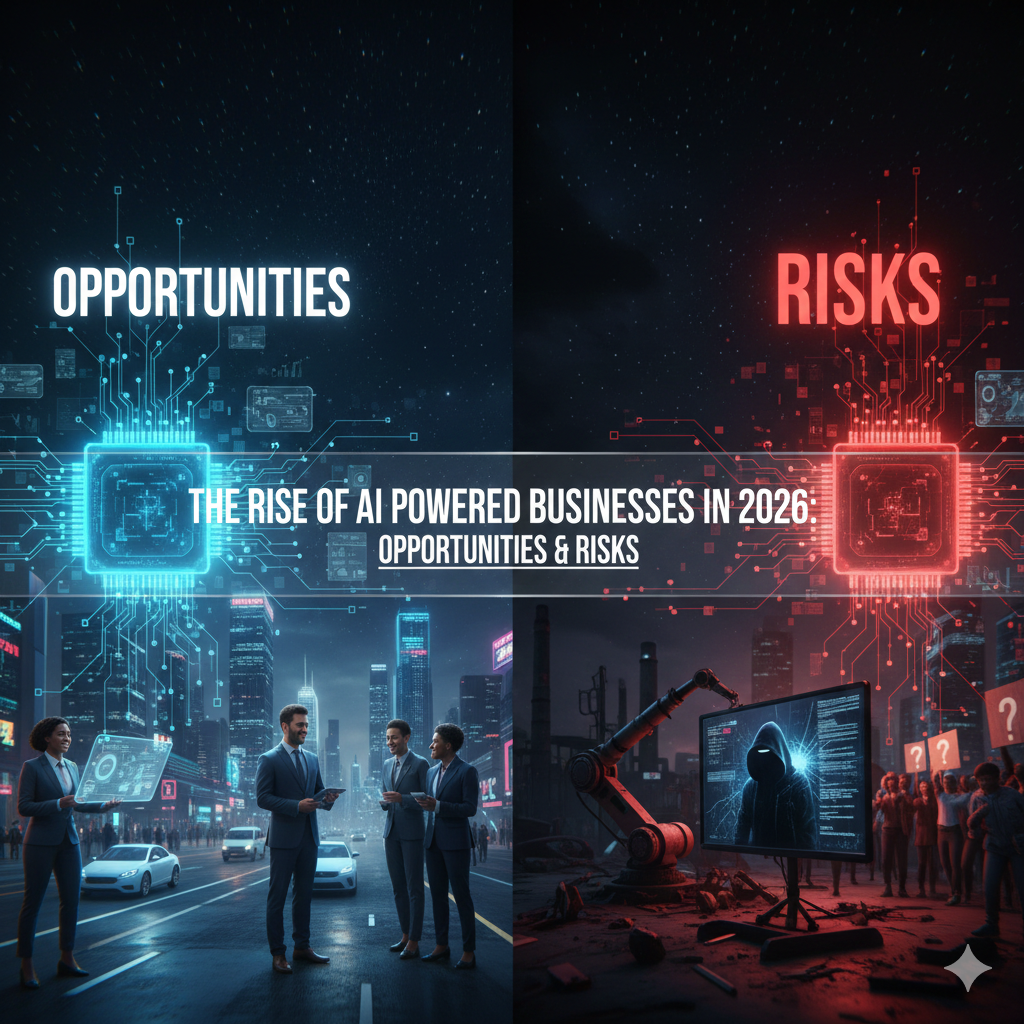


The Rise of AI-Powered Businesses in 2026: Opportunities & Risks
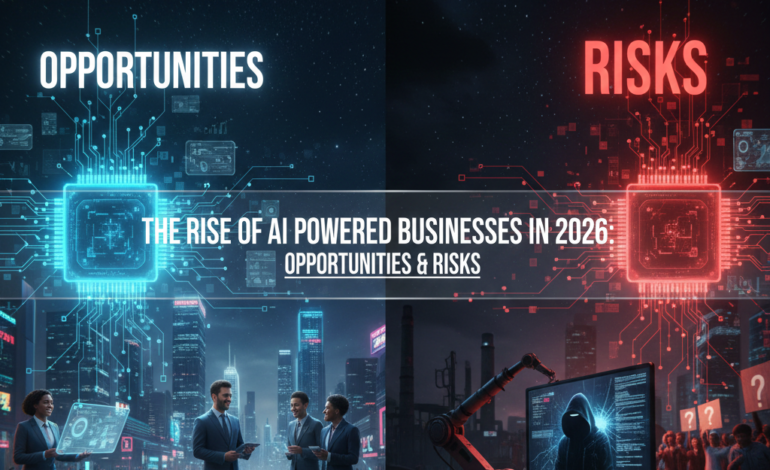

Artificial intelligence has moved beyond experimental pilots and theoretical discussions. By 2026, it is a fundamental driver of corporate strategy. Businesses that once viewed AI as a niche technological upgrade now treat it as a core component of their operational infrastructure. From automating complex supply chains to delivering hyper-personalized customer experiences, AI is reshaping how value is created and delivered in the global economy.
This shift is not merely about adopting new software tools. It represents a fundamental restructuring of business models. Companies are increasingly defining themselves not just by the products they sell, but by the intelligence that powers their operations. This transition brings significant opportunities for efficiency and innovation, yet it also introduces new risks related to ethics, data security, and workforce displacement.
For entrepreneurs and business leaders, understanding this landscape is critical. The competitive advantage of the next decade will likely belong to those who can effectively integrate AI while navigating the regulatory and societal challenges that come with it. This analysis explores the state of AI-powered businesses in 2026, examining the opportunities they capture and the risks they must manage.
What Are AI-Powered Businesses?
An AI-powered business is an organization where artificial intelligence is central to its value proposition and operational model. Unlike traditional companies that might use software for basic tasks like accounting or email, an AI-powered business integrates machine learning and data analytics into the core of its decision-making processes.
These organizations leverage algorithms to optimize workflows, predict market trends, and automate customer interactions. For example, a logistics company in 2026 might use AI not just to track packages, but to autonomously reroute fleets in real-time based on weather patterns and traffic data, minimizing delays without human intervention. Similarly, a streaming service uses deep learning to curate content so effectively that the algorithm itself becomes the primary product feature.
AI Integration Across Industries
The scope of AI integration has widened significantly. In manufacturing, predictive maintenance algorithms foresee equipment failures before they occur, reducing downtime. In professional services, generative AI drafts legal contracts or marketing copy, allowing human professionals to focus on strategy. This widespread adoption suggests that “AI-powered” is no longer a label for tech startups alone; it is becoming a standard for competitive enterprises across all sectors.
Why AI Adoption Is Accelerating in 2026
The acceleration of AI adoption in 2026 is driven by two primary factors: the tangible gains in productivity through automation and the intense pressure to remain competitive.
Automation and Productivity Gains
The economic argument for AI has become undeniable. Businesses are seeing measurable returns on investment through the automation of routine cognitive tasks. Tasks that previously required hours of human labor—such as data entry, basic code generation, or initial customer support inquiries—are now handled instantly by AI systems. This shift allows capital and human talent to be redeployed toward higher-value activities, such as strategic planning and creative problem-solving.
Competitive Pressure and Innovation
Beyond efficiency, fear of obsolescence is a powerful motivator. As market leaders integrate AI to lower costs and speed up product development, competitors are forced to follow suit or risk losing market share. Innovation cycles have shortened; companies leveraging AI can prototype, test, and launch products faster than those relying on traditional R&D methods. This dynamic creates a compounding effect, where early adopters gain advantages that are increasingly difficult for laggards to overcome.
Key Opportunities Created by AI-Powered Businesses
The integration of AI opens several avenues for value creation. These opportunities generally fall into categories of efficiency, insight, revenue generation, and customer engagement.
Operational Efficiency and Cost Reduction
The most immediate benefit for many organizations is the reduction of operational costs. By automating repetitive tasks, businesses can scale their operations without a linear increase in headcount. For instance, financial institutions use AI to process loan applications and detect fraud, significantly reducing the cost per transaction. In retail, automated inventory management systems ensure optimal stock levels, reducing both storage costs and lost sales due to stockouts.
Data-Driven Decision Making
Data is often described as the new oil, but it is useless without the engine to process it. AI serves as that engine. Through predictive analytics, businesses can anticipate market shifts and consumer behavior with greater accuracy. A fashion retailer can predict upcoming trends based on social media analysis, while a manufacturing firm can forecast raw material shortages. This ability to make informed decisions based on real-time data reduces uncertainty and allows for more agile strategic planning.
New Revenue Models
AI is not just optimizing existing processes; it is creating entirely new ways to generate revenue. The “AI-as-a-Service” model has exploded, allowing companies to monetize their proprietary algorithms and data sets. Furthermore, businesses are developing personalized products that were previously impossible to produce at scale. Personalized education platforms, for example, adapt curriculums to individual student learning speeds, creating a premium service that commands higher prices.
Improved Customer Experience
Customer expectations have evolved. In 2026, consumers expect instant, personalized interactions. AI-powered chatbots and virtual assistants provide 24/7 support that is increasingly indistinguishable from human interaction for standard queries. Recommendation engines have become sophisticated enough to anticipate needs before the customer is fully aware of them, driving cross-selling and up-selling opportunities while simultaneously improving customer satisfaction.
Industries Leading the AI Business Transformation
While AI impacts every sector, certain industries have adopted these technologies more aggressively due to the nature of their data and operations.
Technology and Software
Unsurprisingly, the technology sector leads the charge. Software companies are embedding AI into every product, from development tools that auto-complete code to design software that generates images from text descriptions. For these companies, AI is not just an operational tool but the very fabric of their product offerings.
Healthcare and Finance
Healthcare and finance are data-rich environments, making them ideal for AI integration. In healthcare, AI assists in diagnostic imaging, drug discovery, and personalized treatment plans, potentially improving patient outcomes while reducing costs. In finance, algorithmic trading, credit scoring, and automated financial advisory services (robo-advisors) are becoming the norm, providing services at a speed and scale human analysts cannot match.
Retail and E-commerce
Retailers use AI to optimize everything from supply chain logistics to personalized marketing campaigns. Dynamic pricing algorithms adjust prices in real-time based on demand, competition, and inventory levels. In physical stores, computer vision technology enables cashier-less checkout experiences, streamlining the shopping process and reducing labor costs.
Risks and Challenges of AI Adoption
Despite the opportunities, the transition to an AI-powered business model is fraught with risks. These challenges are not merely technical but extend to legal, ethical, and societal domains.
Ethical and Regulatory Concerns
As AI systems make more consequential decisions—such as who gets a loan or who is prioritized for medical treatment—questions of bias and fairness become critical. Algorithms trained on historical data may inadvertently perpetuate existing biases. Furthermore, the lack of transparency in “black box” AI models makes it difficult to explain how specific decisions are reached, posing challenges for accountability and compliance with anti-discrimination laws.
Data Privacy and Security Risks
AI systems require vast amounts of data to function effectively. This reliance makes them prime targets for cyberattacks. A breach in an AI system can expose sensitive customer information or proprietary business intelligence. Additionally, businesses must navigate a complex web of global data privacy regulations, such as GDPR in Europe, which impose strict penalties for mishandling user data.
Workforce Disruption
The automation of tasks inevitably leads to workforce displacement. While AI creates new roles, the transition can be painful. Workers whose skills are rendered obsolete face uncertainty, and businesses must manage the cultural and morale impact of automation. There is a growing need for strategies that balance technological efficiency with social responsibility and workforce stability.
AI Strategy for Modern Businesses
To navigate these opportunities and risks, businesses require a coherent AI strategy. It is not enough to simply purchase tools; organizations must fundamentally rethink how they operate.
Integrating AI into Workflows
Successful integration requires identifying specific pain points where AI can deliver value. This involves mapping out existing workflows and pinpointing bottlenecks that automation or predictive analytics can resolve. It also requires a technical infrastructure capable of supporting data flow and integration between disparate systems. Siloed data is the enemy of effective AI implementation.
Upskilling and Talent Development
The human element remains crucial. Businesses must invest in upskilling their workforce to work alongside AI systems. This includes training employees on how to interpret AI insights, manage AI tools, and focus on the creative and interpersonal tasks that machines cannot replicate. Attracting top technical talent—data scientists, machine learning engineers, and ethicists—is also a priority for maintaining a competitive edge.
Investment and Market Trends Around AI Businesses
Capital allocation in 2026 heavily favors AI-centric initiatives.
Venture Capital and Enterprise Spending
Venture capital continues to flow into AI startups, particularly those solving specific industry problems or developing novel infrastructure. Meanwhile, established enterprises are allocating significant portions of their IT budgets to AI development and deployment. This spending is shifting from experimental R&D to core infrastructure investment, signaling the maturity of the technology.
Competition Among Major Tech Players
The landscape is dominated by a few major technology giants who provide the foundational models and cloud infrastructure upon which other businesses build. However, this concentration of power creates concerns about market monopolies. Smaller players are finding niches by developing specialized applications or industry-specific models that offer better performance for focused tasks than general-purpose tools.
AI-Powered Startups vs Established Companies
The dynamic between startups and incumbents is shifting.
Speed of Innovation
Startups possess the advantage of agility. Unencumbered by legacy systems and bureaucratic processes, they can adopt the latest AI technologies rapidly and pivot their business models as needed. This allows them to disrupt traditional industries by offering superior user experiences or significantly lower costs.
Scale and Infrastructure Advantages
Conversely, established companies have the advantage of data and distribution. An incumbent bank has decades of transaction data to train its fraud detection models, a resource a fintech startup cannot easily replicate. Furthermore, large enterprises have the financial resilience to weather the initial costs and failures often associated with implementing complex AI systems.
Role of Regulation and Governance
As AI becomes ubiquitous, government oversight is increasing.
Global Policy Developments
Governments worldwide are developing frameworks to regulate AI. These policies focus on safety, transparency, and data rights. For global businesses, this creates a fragmented regulatory landscape where a system compliant in one jurisdiction may be illegal in another. Navigating this complexity requires dedicated legal and compliance resources.
Responsible AI Frameworks
To mitigate risk and build trust, forward-thinking companies are voluntarily adopting responsible AI frameworks. these frameworks establish internal governance structures to ensure AI is used ethically. This includes regular auditing of algorithms for bias, ensuring human oversight for critical decisions, and maintaining transparency with customers about when and how AI is being used.
Future Outlook for AI-Powered Companies
Looking beyond 2026, the trajectory points toward increasing autonomy and personalization.
Autonomous Operations
The next phase of AI evolution involves autonomous agents capable of executing complex goals with minimal human input. We may see entire departments—such as supply chain management or basic cybersecurity defense—run largely by autonomous systems that self-correct and optimize in real-time.
Hyper-Personalized Services
Personalization will move beyond marketing to product design. Manufacturing and service delivery will become flexible enough to tailor individual outputs to specific user needs at mass-production costs. This shift will redefine customer loyalty, as switching costs increase for consumers who have products perfectly adapted to their preferences.
Conclusion
The rise of AI-powered businesses in 2026 represents a pivotal moment in economic history. The convergence of data, computing power, and advanced algorithms offers unprecedented opportunities to enhance efficiency and innovation. However, these benefits are accompanied by significant risks that require careful management.
For entrepreneurs and business leaders, the path forward involves a balanced approach. It requires aggressive adoption of technology to remain competitive, tempered by a thoughtful strategy regarding ethics, security, and workforce management. Those who can navigate this duality will define the next era of global business.
FAQs – AI-Powered Businesses in 2026
What defines an AI-powered business?
An AI-powered business is an organization that integrates artificial intelligence into its core operations and decision-making processes to drive value, efficiency, and innovation.
Which industries benefit most from AI?
Technology, finance, healthcare, and retail are currently seeing the most significant benefits due to their high volume of data and potential for automation.
What risks do AI companies face?
Key risks include ethical concerns regarding bias, data privacy and security vulnerabilities, regulatory compliance challenges, and workforce displacement issues.
Will AI replace traditional businesses?
AI is unlikely to replace businesses entirely but will likely replace business models that fail to adapt. Traditional companies that do not integrate AI may find themselves unable to compete on cost or quality.
Is AI adoption expensive for small businesses?
While custom enterprise solutions can be costly, the proliferation of “AI-as-a-Service” platforms has made AI tools increasingly accessible and affordable for small and medium-sized enterprises.