




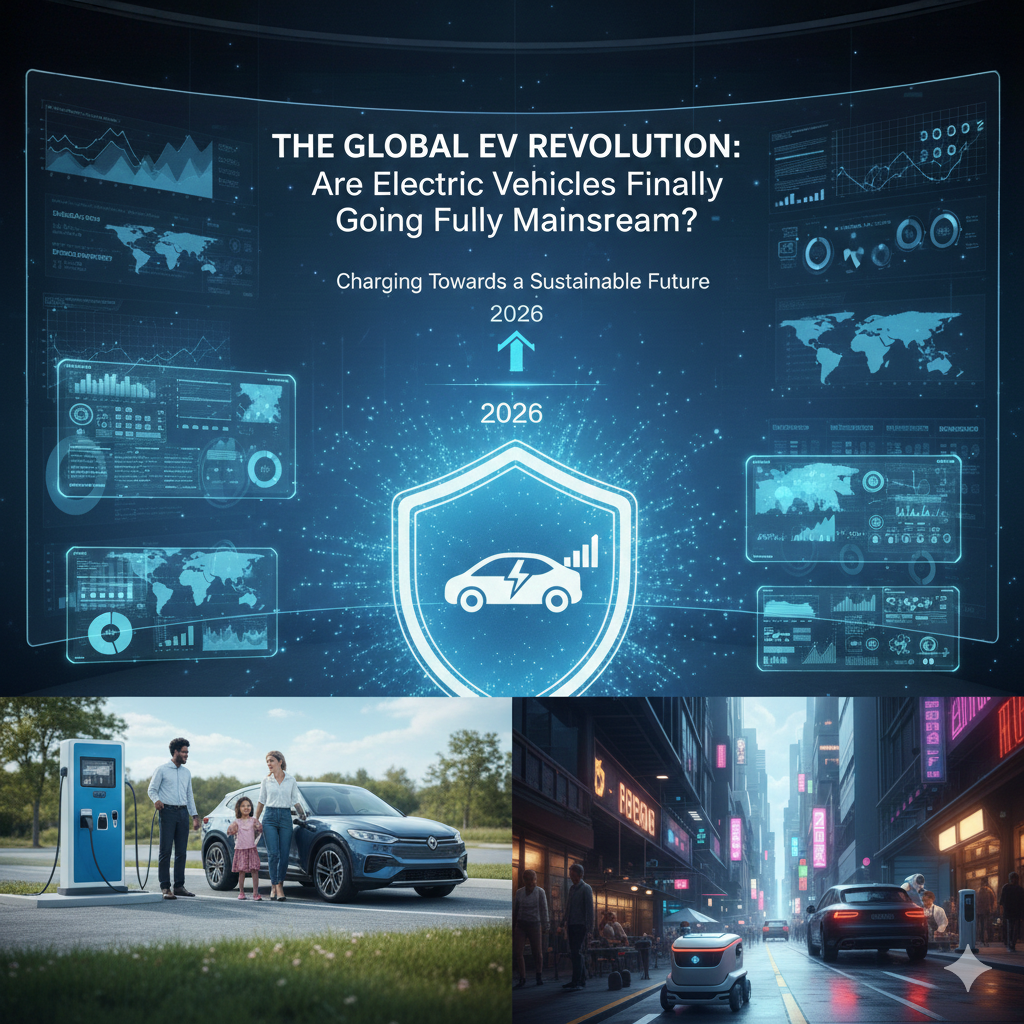
For decades, the internal combustion engine (ICE) was the undisputed king of the road. But walk down a street in Oslo, Shanghai, or San Francisco today, and the silence is telling. The automotive landscape is undergoing its most significant transformation in a century. What started as a niche experiment in sustainability has accelerated into a global industrial race.
The transition to electric mobility is no longer just a vision for the future; it is a current economic and technological reality. However, the question remains: have we truly reached mass adoption, or are we still in the “early adopter” phase? As we approach 2026, the industry sits at a critical juncture where policy, technology, and consumer sentiment intersect. This article explores the current state of the global EV revolution, examining the forces propelling it forward and the hurdles that remain before electric vehicles can be considered fully mainstream.
What Is Driving the Global EV Revolution?
The momentum behind electric vehicles (EVs) isn’t the result of a single breakthrough but a convergence of factors. It is a push-and-pull dynamic between aggressive climate goals and rapid technological maturation.
Environmental goals and policy incentives
Governments worldwide have recognized that decarbonizing the transport sector is non-negotiable for meeting climate targets. This has led to a regulatory landscape designed to phase out fossil-fuel vehicles. The European Union’s “Fit for 55” package, aimed at reducing net greenhouse gas emissions by at least 55% by 2030, includes strict CO2 standards for cars. Similarly, the Inflation Reduction Act (IRA) in the United States has injected billions into the domestic supply chain, incentivizing both manufacturing and consumer purchases. These policies act as a forcing function, compelling automakers to pivot away from ICE production lines or face severe financial penalties.
Advances in battery technology
While policy provides the push, technology provides the pull. The defining barrier to EV adoption has historically been the battery—its cost, weight, and range. In the last decade, lithium-ion battery prices have plummeted by nearly 90%, approaching the critical threshold where EVs reach price parity with gas cars without subsidies. Simultaneously, energy density has improved, allowing for longer ranges in smaller packages. Innovations like structural battery packs and new chemistries (such as Lithium Iron Phosphate, or LFP) are making EVs more durable, safer, and cheaper to produce, fundamentally changing the value proposition for the average consumer.
EV Adoption Trends Around the World
The revolution is global, but it is not happening at the same speed everywhere. Adoption rates vary wildly depending on local infrastructure, average income, and government support.
Growth in North America, Europe, and Asia
China remains the undisputed heavyweight champion of the EV world. Driven by aggressive state planning and a robust domestic manufacturing sector (led by giants like BYD), China accounts for roughly 60% of global electric car sales. In major Chinese cities, green license plates—signifying new energy vehicles—are ubiquitous.
Europe follows closely, with countries like Norway serving as a glimpse into the future, where EVs constitute over 80% of new car sales. The broader EU market sees consistent growth, supported by dense charging networks and high fuel taxes that make ICE ownership expensive.
North America, particularly the United States, has seen slower but steady growth. Adoption is highly regional, concentrated in states like California, but federal incentives are beginning to level the playing field across the continent.
Emerging market adoption challenges
In contrast, emerging markets in Latin America, Africa, and Southeast Asia face a different reality. Here, the “electric revolution” is often led by two-wheelers and three-wheelers rather than passenger cars. High upfront costs and unstable electricity grids remain significant barriers. However, nations like India and Vietnam are fostering their own EV ecosystems, focusing on affordable micro-mobility solutions and electric buses to address urban pollution, signaling that the revolution will look different in the Global South.
Are Electric Vehicles Becoming Mainstream in 2026?
To determine if EVs are “mainstream,” we must look beyond sales figures to the broader ecosystem. The year 2026 is often cited by analysts as a potential tipping point where the technology moves from early adopters to the early majority.
Consumer Demand and Market Growth
Changing buyer preferences
Consumer sentiment is shifting from curiosity to practicality. Early EV buyers were often tech enthusiasts or staunch environmentalists. Today, buyers are motivated by performance, lower operating costs, and convenience. Surveys indicate that a growing percentage of consumers are considering an EV for their next vehicle purchase, driven by the desire to avoid volatile gas prices and the appeal of instant torque and quiet cabins. The “cool factor” of EVs has normalized; they are now simply viewed as better cars by a growing segment of the population.
Expansion of Charging Infrastructure
Public charging networks and home solutions
For EVs to go fully mainstream, refueling must be as easy as—or easier than—pumping gas. Public charging networks are expanding rapidly, with major investments from both governments and private entities like Tesla (opening its Supercharger network) and energy companies like Shell and BP. Furthermore, the standardization of charging ports (such as the widespread adoption of NACS in North America) is simplifying the user experience. For homeowners, the ability to wake up to a full “tank” every morning remains the killer app of EV ownership, though this creates a disparity for apartment dwellers that cities are still struggling to solve.
Price Competitiveness with Gas Vehicles
Total cost of ownership trends
The sticker price remains a hurdle, but the gap is closing. When calculating the Total Cost of Ownership (TCO)—which factors in fuel, maintenance, insurance, and depreciation—EVs often come out ahead of their ICE counterparts after a few years of ownership. As manufacturing scales and battery costs continue to drop, the upfront purchase price of compact EVs is expected to match ICE vehicles in many markets by the mid-2020s, removing the final economic argument against going electric.
Role of Governments and Climate Policies
The invisible hand of the market is being guided firmly by the visible hand of the state. Government intervention remains the backbone of the transition.
Subsidies and regulations
Financial incentives, such as tax credits and rebates, cushion the blow of higher upfront costs. However, many governments are now shifting from carrots to sticks. Low-emission zones in cities like London and Paris charge fees for polluting vehicles, effectively banning older diesel and gas cars from city centers. These local regulations make ICE ownership increasingly impractical for urban residents.
Net-zero targets influencing adoption
National commitments to reach net-zero emissions by 2050 act as a roadmap for the industry. To hit these targets, the sale of new ICE vehicles must end well before 2050 to allow the fleet to turn over. This has led many nations to set hard deadlines (2030 or 2035) for the end of gas car sales, giving automakers and consumers a clear countdown clock.
Technology Advancements Accelerating EV Growth
The cars driving on the road in 2026 are fundamentally different from the electric models of 2016.
Battery range improvements
Range anxiety—the fear of running out of power before reaching a charger—is diminishing. New EVs standardly offer ranges exceeding 300 miles (480 km), sufficient for the vast majority of driving needs. The emergence of solid-state batteries promises to be a game-changer, potentially offering double the range and significantly faster charging times compared to current liquid electrolyte batteries.
Software-driven vehicle features
EVs are increasingly defined by their software rather than their mechanics. “Software-Defined Vehicles” (SDVs) allow manufacturers to improve range, charging speed, and infotainment features via over-the-air (OTA) updates. This shift means a car bought in 2026 could be better in 2028 than the day it was purchased, a concept previously foreign to the automotive industry.
Challenges Slowing Full Mainstream Adoption
Despite the optimism, the road ahead is not without potholes. Several structural and economic barriers could throttle the pace of adoption.
Charging availability gaps
While infrastructure is growing, “charging deserts” persist, particularly in rural areas and low-income neighborhoods. Furthermore, the reliability of public chargers is a major pain point; a broken charger can strand a driver, damaging public confidence in the technology. Until public charging is as ubiquitous and reliable as gas stations, hesitation will remain.
Supply chain and material costs
Batteries require lithium, cobalt, nickel, and graphite. The supply chains for these minerals are geographically concentrated and subject to geopolitical volatility. A sudden spike in raw material costs can reverse years of price declines. Moreover, the ethical concerns regarding mining practices in certain regions pose a reputational risk to the “clean” image of the industry.
Impact of EVs on the Global Auto Industry
The transition to electric is an existential challenge for legacy automakers. Companies that have spent a century perfecting the combustion engine must now reinvent themselves.
Shift from traditional manufacturing
Building an EV is simpler than building an ICE car—an electric motor has a fraction of the moving parts of a gas engine. This requires a complete retooling of factories and a retraining of the workforce. Labor unions are understandably concerned, as EV production generally requires fewer workers. This industrial pivot is costly and complex, leading to restructuring and friction within major automotive conglomerates.
New competition among automakers
The barrier to entry for making cars has lowered, allowing tech companies and startups to challenge established players. Tesla proved it was possible; now, Chinese manufacturers like NIO and XPeng are expanding globally, offering high-tech vehicles at competitive prices. Legacy brands are no longer just competing with each other but with agile newcomers who view the car as a computer on wheels.
EV Ownership Experience in 2026
For the consumer, the switch to electric changes the relationship with the vehicle.
Maintenance and operating costs
The days of oil changes, spark plug replacements, and transmission flushes are numbered. With fewer moving parts, EVs require significantly less scheduled maintenance. Brake pads last longer due to regenerative braking systems. This reduction in ongoing hassle and cost is a powerful driver for customer retention; once a driver goes electric, they rarely switch back.
Smart charging and energy management
The EV is becoming part of the energy grid. Vehicle-to-Grid (V2G) technology allows cars to discharge energy back into the home or the grid during peak hours. In 2026, an EV is not just a mode of transport but a mobile battery storage unit, potentially earning the owner money by stabilizing the local power grid and lowering home energy bills.
Environmental Debate Around Electric Vehicles
It is essential to address the nuance of EV sustainability.
Lifecycle emissions discussion
Critics often point out that manufacturing an EV generates more carbon emissions than building a gas car, primarily due to battery production. This is factually accurate. However, research consistently shows that an EV pays off this “carbon debt” within a few years of driving, depending on the energy mix of the grid it charges from. Over a full lifecycle, an EV is significantly cleaner than an ICE vehicle.
Recycling and sustainability concerns
The end-of-life plan for millions of tons of batteries is a looming challenge. The industry is rapidly developing battery recycling capabilities to recover valuable metals, creating a circular economy that reduces the need for new mining. The success of these recycling programs will be crucial for the long-term sustainability credential of the EV revolution.
Future Outlook for Electric Mobility
As we look beyond 2026, the electrification of transport expands beyond the personal passenger car.
Autonomous EV integration
Electrification and automation are parallel trends that are beginning to merge. Robotaxis and autonomous shuttles are predominantly electric, leveraging the precise control of electric motors. While full autonomy remains a distant goal for widespread use, the integration of advanced driver-assistance systems in EVs continues to accelerate.
Expansion of electric trucks and fleets
Perhaps the most impactful shift will be in commercial transport. Electric delivery vans are already common, but the electrification of long-haul trucking is the next frontier. Technologies like the Tesla Semi and electric trucks from Volvo and Daimler are proving that heavy-duty transport can be decarbonized, drastically reducing emissions from the logistics sector.
FAQs – Global EV Revolution
Are electric vehicles truly mainstream now?
In specific markets like Norway and China, yes. Globally, they are transitioning from early adoption to the mass market. By 2026, with increased model variety and lower prices, they are expected to be a standard choice for new car buyers in developed nations.
What makes EV adoption grow faster?
A combination of government mandates banning ICE sales, subsidies making cars affordable, and the rapid expansion of reliable fast-charging infrastructure accelerates adoption.
Are EVs cheaper to own long term?
Generally, yes. While the purchase price can be higher, the savings on fuel and maintenance usually result in a lower total cost of ownership over the life of the vehicle.
Is charging infrastructure improving globally?
Yes, but unevenly. China, Europe, and North America are seeing massive investments, but reliability and rural access remain challenges that governments and private companies are actively addressing.
Will EVs replace gas cars completely?
Eventually, for new sales. Most major automakers plan to stop selling gas cars between 2030 and 2040. However, existing gas cars will remain on the road for decades, meaning a mixed fleet will exist for a long time.
The Road Ahead
The trajectory is clear: the age of the combustion engine is winding down. While 2026 may not mark the complete extinction of gas cars, it will likely be remembered as the point of no return—the moment when electric vehicles ceased to be an alternative and simply became the standard. The revolution is fueled by necessity, powered by technology, and steered by policy. For consumers and industries alike, the question is no longer if they will transition to electric, but when.


