




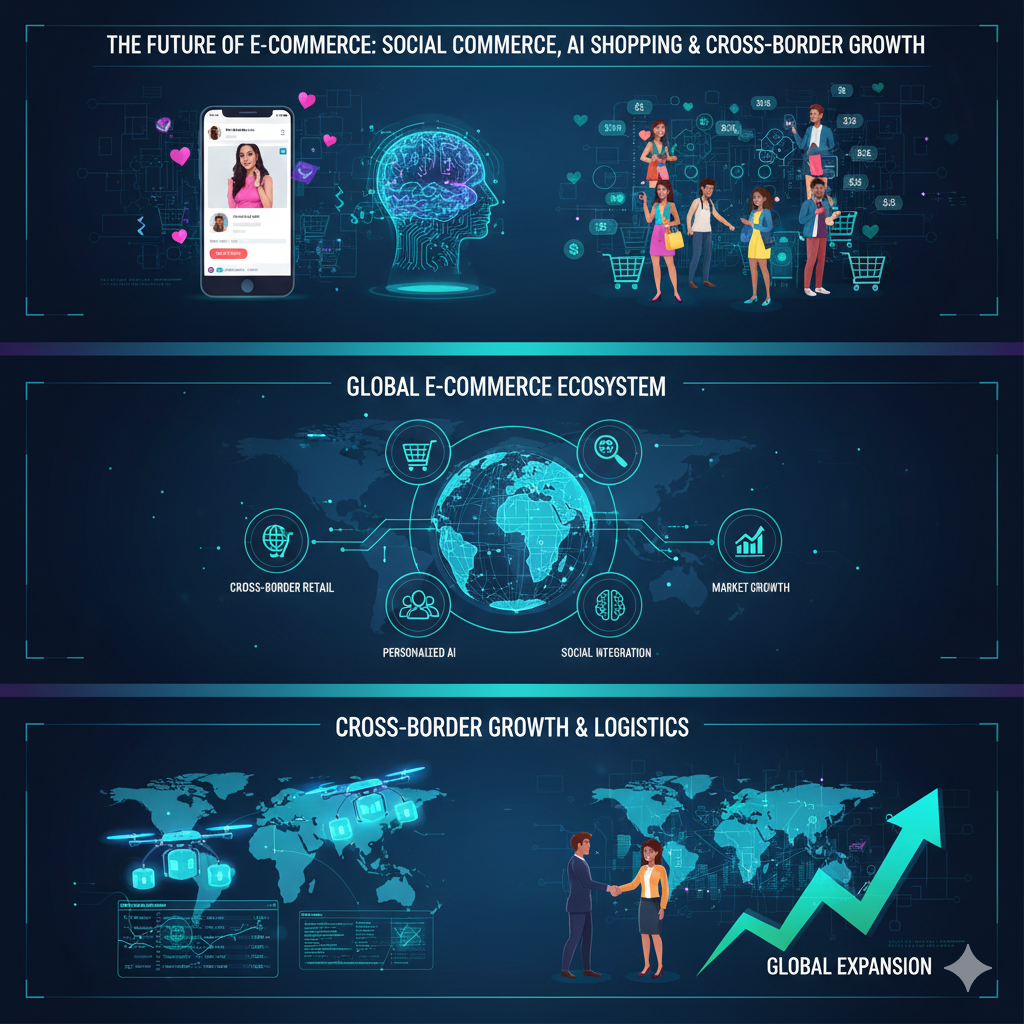
E-commerce was once defined by simple online storefronts—digital versions of physical catalogs. Today, that definition is expanding rapidly. The convergence of social media, artificial intelligence, and global logistics is reshaping how consumers discover, evaluate, and purchase products. For business leaders and entrepreneurs, understanding these shifts is no longer optional; it is a necessity for survival in a crowded digital marketplace.
The next decade of online retail will not be defined by who has the best website, but by who can best integrate shopping into the daily digital lives of consumers. From scrolling through a social feed to interacting with an AI assistant, the friction between inspiration and transaction is disappearing. However, this growth brings complexity. Rising customer acquisition costs, intricate cross-border regulations, and heightened privacy concerns create a landscape that is as challenging as it is promising.
This analysis explores the core drivers shaping the future of e-commerce, examining the rise of social commerce, the integration of AI, and the expansion of global markets.
What Is Driving the Future of E-Commerce?
Several macro trends are converging to push e-commerce into its next phase. At the center of this shift is changing consumer behavior. Shoppers are no longer distinct from social media users or content consumers; these identities have merged. The expectation is for commerce to happen where the consumer is, rather than requiring the consumer to travel to a specific digital destination.
Mobile-first ecosystems are the primary catalyst. With smartphones serving as the primary interface for the internet in many emerging markets, and the dominant device for discovery in developed ones, e-commerce infrastructure is being rebuilt to prioritize small screens, instant payments, and app-based interactions. This transition is moving retail away from search-engine dominance toward discovery-based shopping.
Rise of Social Commerce
Social commerce is arguably the most significant shift in digital retail since the invention of the shopping cart. It moves beyond using social media for marketing and integrates the checkout process directly into platforms like TikTok, Instagram, and Pinterest.
Shopping Through Social Media Platforms
The distinction between entertainment and shopping is blurring. Platforms are evolving into marketplaces where users can purchase items without leaving the app. This “closed-loop” experience reduces cart abandonment by eliminating steps in the buyer’s journey.
Live shopping is a key component of this trend. Popularized in Asian markets, particularly China, live-stream selling allows creators to demonstrate products in real-time, answer questions, and offer limited-time discounts. This format mimics the interactivity of in-store shopping but scales it to a global audience. While adoption in Western markets has been slower, the infrastructure is being laid for live commerce to become a standard sales channel.
Influencer-Led Product Discovery
The traditional funnel of awareness-to-purchase is being replaced by community-based decision-making. Consumers increasingly look to influencers and creators rather than brands for product recommendations. Trust is shifted from corporate entities to individual personalities.
This dynamic changes how brands approach marketing. Instead of broad programmatic advertising, successful strategies often involve decentralized networks of micro-influencers who can speak authentically to niche communities. Product discovery becomes organic, woven into the content users are already consuming.
AI-Powered Shopping Experiences
Artificial Intelligence is moving from a backend optimization tool to a front-facing customer interface. It is fundamentally altering how shoppers find what they need and how retailers operate.
Personalized Product Recommendations
For years, “personalization” meant simple algorithms suggesting “customers who bought this also bought that.” Modern AI goes much deeper. By analyzing browsing history, purchase data, and even real-time behavior (like how long a user hovers over an image), AI can predict intent with high accuracy.
These systems create hyper-personalized storefronts where no two users see the same arrangement of products. This level of curation helps overcome “choice paralysis,” guiding consumers toward products they are statistically most likely to purchase.
Conversational Commerce and Chatbots
The era of scripted, frustrating chatbots is fading. Large Language Models (LLMs) enable virtual assistants to understand context, nuance, and complex queries. Shoppers can now ask open-ended questions—”I need a gift for a coffee lover under $50″—and receive tailored suggestions.
This conversational commerce mimics the role of a knowledgeable sales associate. It provides immediate support, handles objections, and facilitates transactions through natural language, making the digital shopping experience feel more human and less transactional.
Visual Search and Smart Checkout
Text-based search is efficient but limited. Visual search allows users to upload photos of items they see in the real world—a pair of shoes on a stranger or a chair in a hotel lobby—and instantly find the exact product or similar alternatives.
Simultaneously, AI is streamlining the checkout process. Predictive algorithms can pre-fill shipping information, select preferred payment methods, and detect fraud in milliseconds, ensuring that the final step of the purchase is as frictionless as the browsing phase.
Cross-Border E-Commerce Growth
The barriers to selling internationally are lowering. What was once the domain of multinational corporations is now accessible to direct-to-consumer (DTC) brands and small businesses.
Global marketplaces serve as the bridge. Platforms like Amazon Global, AliExpress, and specialized regional players handle much of the logistical complexity, allowing sellers to reach customers in different countries without establishing physical operations there.
However, success in cross-border trade requires localization. It is not enough to simply translate a website. Merchants must offer local currency pricing, support preferred regional payment methods (such as digital wallets specific to a country), and navigate complex customs and tax regulations. Brands that fail to localize the checkout experience often see high abandonment rates, regardless of product quality.
How Technology Is Changing Online Retail
Behind the storefront, technology is revolutionizing operations. Automation in fulfillment centers—using robotics for picking and packing—is standardizing two-day (or even same-day) delivery expectations.
Data-driven marketing is also evolving. As privacy regulations restrict third-party data tracking, retailers are pivoting to “first-party” data strategies. By using AI to analyze the data they collect directly from customers, businesses can build robust customer profiles without relying on external tracking pixels. This shift emphasizes customer retention and lifetime value over aggressive acquisition.
Consumer Expectations in Modern E-Commerce
The bar for customer satisfaction is constantly rising. Speed, convenience, and personalization are now baseline expectations rather than differentiators.
Today’s consumer expects a seamless omnichannel experience. They may discover a product on social media, research it on a mobile app, view it in a physical store, and finally purchase it via a desktop browser. They expect their cart, preferences, and loyalty points to follow them across every touchpoint. Disconnected experiences—where the app doesn’t know what happened in the store—lead to frustration and lost loyalty.
Challenges Facing the Future of E-Commerce
Despite the growth, the industry faces significant headwinds.
Privacy Regulations and Data Security
As data becomes the lifeblood of e-commerce, protecting it becomes critical. Regulations like GDPR in Europe and various state-level laws in the US are forcing companies to be transparent about data usage. Breaches not only result in heavy fines but also cause irreparable damage to brand trust. Balancing personalization with privacy is the central ethical dilemma for modern retailers.
Rising Acquisition Costs
The digital advertising market is saturated. The cost to acquire a customer (CAC) through paid channels like Facebook and Google has risen steadily. This trend forces businesses to focus on retention, organic community building, and improving unit economics, rather than relying solely on paid ads for growth.
Global Supply Chain Complexity
Recent years have exposed the fragility of global supply chains. Geopolitical tensions, labor shortages, and rising fuel costs introduce volatility. E-commerce businesses must now build resilience into their logistics, often by diversifying suppliers or moving inventory closer to the end consumer, which increases operational complexity.
Impact on Small Businesses and Entrepreneurs
The democratization of e-commerce tools cuts both ways. On one hand, small businesses have unprecedented access to global audiences. A niche artisan in a rural area can sell to customers in major cities worldwide using off-the-shelf platforms.
On the other hand, they must compete with the infrastructure of giants. Small businesses often struggle to match the free shipping, easy returns, and instant support offered by large marketplaces. The challenge for entrepreneurs is to differentiate through brand story, unique product offerings, and authentic community engagement—areas where large corporations often struggle.
Role of Mobile Commerce in Global Growth
The future of e-commerce is mobile. In many developing economies, the desktop era was skipped entirely. “Super apps”—platforms that combine messaging, payments, and shopping into a single ecosystem—are dominating markets in Asia and Latin America.
For Western businesses, this signals a need to optimize for app-based purchasing trends. The mobile checkout experience must be flawless. Digital wallets (Apple Pay, Google Pay) are essential to reducing friction on small screens where typing credit card numbers is cumbersome.
Sustainability and Ethical E-Commerce
Consumers, particularly younger generations, are scrutinizing the environmental impact of their online shopping. The “Amazon effect” of instant delivery has a high carbon footprint due to packaging waste and last-mile logistics.
There is a growing demand for eco-friendly packaging and transparent sourcing. Brands that can prove ethical labor practices and supply chain sustainability are gaining a competitive advantage. Re-commerce (selling used or refurbished goods) is also growing, driven by both environmental concerns and economic pragmatism.
Future Trends to Watch Beyond 2026
Looking further ahead, several emerging technologies promise to disrupt the status quo again.
AR/VR Shopping Experiences
Augmented Reality (AR) allows customers to “try on” makeup virtually or see how a sofa fits in their living room before buying. As hardware improves (such as VR headsets and smart glasses), immersive shopping environments could replicate the feeling of browsing a physical store from home.
Voice Commerce and Automation
As smart speakers and voice assistants become ubiquitous, voice commerce will likely expand for replenishment purchases (e.g., reordering household staples). Furthermore, automated commerce—where connected devices order supplies automatically when they run low—may alter the concept of “shopping” for commodities entirely.
E-Commerce Strategic Outlook
The future of e-commerce is not a single destination but a continuous evolution. The convergence of social interaction, artificial intelligence, and global connectivity offers immense opportunity for growth. However, realizing this potential requires navigating a landscape filled with technical, logistical, and regulatory hurdles. For entrepreneurs and enterprises alike, agility and a deep understanding of consumer behavior will be the defining metrics of success.
FAQs – Future of E-Commerce
Social commerce refers to the buying and selling of products and services directly within social media platforms. It differs from social media marketing by allowing the transaction to occur without the user leaving the app, creating a seamless path from discovery to purchase.
How does AI improve online shopping?
AI improves online shopping by personalizing product recommendations, powering conversational chatbots for customer service, enabling visual search, and optimizing backend logistics like inventory management and fraud detection.
Why is cross-border e-commerce growing?
Cross-border e-commerce is growing due to improved global logistics, easier payment processing for multiple currencies, and the rise of online marketplaces that connect sellers with international audiences. It allows consumers to access products unavailable in their local markets.
Will traditional online stores disappear?
Traditional online stores are unlikely to disappear, but they will evolve. While social commerce and marketplaces are growing, branded websites remain crucial for data ownership, brand storytelling, and customer retention. They will likely function as the central hub of a broader omnichannel strategy.
What challenges will e-commerce face in the future?
Key challenges include navigating strict data privacy regulations, managing rising customer acquisition costs, securing complex global supply chains, and meeting consumer demands for sustainable and ethical business practices.


