




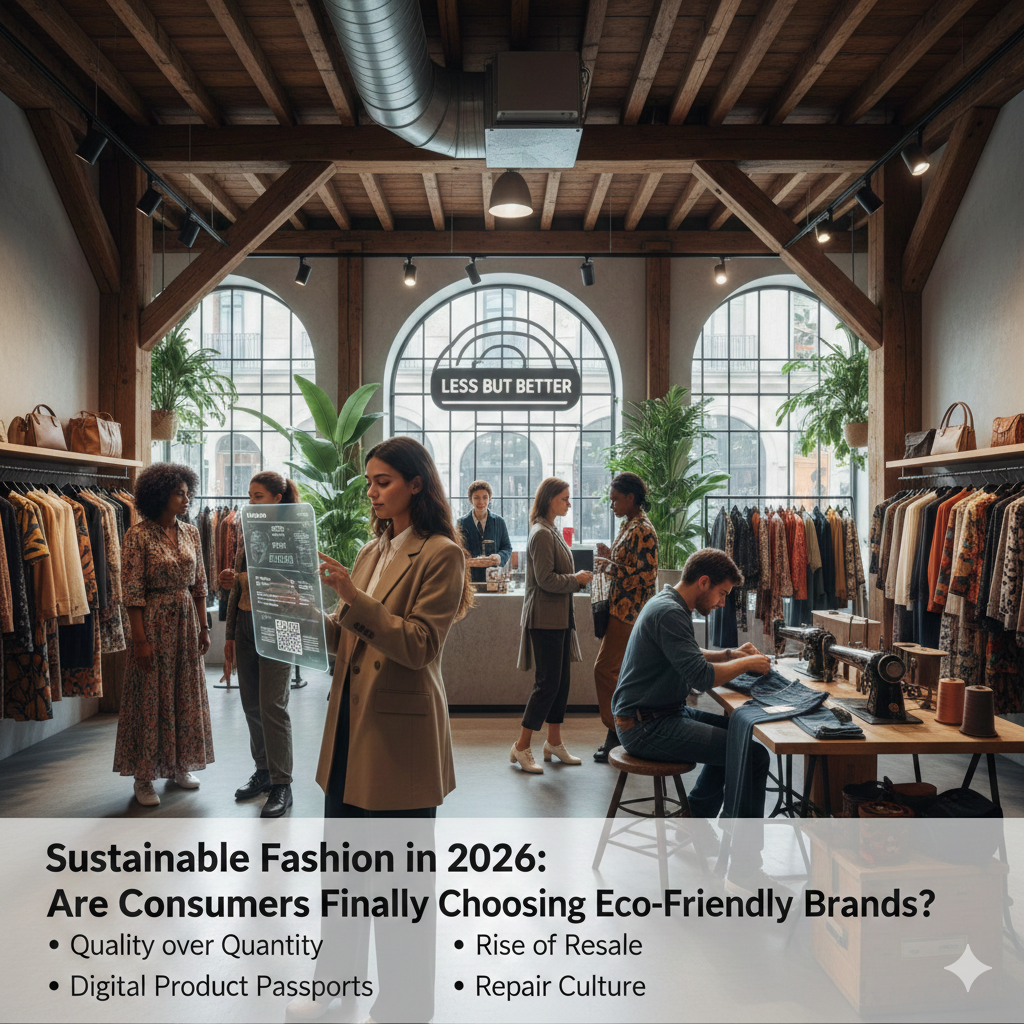
Open your closet doors and take a look inside. How many items do you see that you haven’t worn in the last year? If you are like most people, that number is likely higher than you would care to admit. For decades, the fashion industry has operated on a model of excess—produce more, buy more, waste more. But as we settle into 2026, the conversation has shifted. The buzzwords of the early 2020s—”circularity,” “transparency,” and “conscious consumption”—are no longer just marketing jargon. They are becoming the standard against which brands are measured.
The environmental cost of clothing has been well-documented. From water usage to microplastics and carbon emissions, the textile industry leaves a heavy footprint. Yet, for years, there was a disconnect between what consumers said they wanted and what they actually purchased. Surveys consistently showed a desire for ethical products, but sales data often told a different story, with ultra-fast fashion giants dominating the market.
Now, the landscape appears to be changing. With stricter regulations coming into force in Europe and North America, and a generation of shoppers who have grown up with the climate crisis as a backdrop, the pressure on brands is mounting. The question remains: has the needle truly moved? Are shoppers finally voting with their wallets, or is the allure of the cheap, trendy garment still too strong to resist? This post explores the reality of the sustainable fashion market in 2026, examining consumer behavior, technological advancements, and the stubborn hurdles that remain.
What Is Sustainable Fashion?
To understand the shift in consumer behavior, we must first define what “sustainable fashion” actually means in the current market. It is a broad term that encompasses two main pillars: environmental integrity and social justice. It is not just about using organic cotton; it is about the entire lifecycle of a garment.
Definition and key principles
Sustainable fashion refers to clothing, shoes, and accessories that are manufactured, marketed, and used in the most sustainable manner possible. This involves minimizing environmental impact through water conservation, energy efficiency, and waste reduction. Crucially, it also operates on the principle of circularity. In a circular model, products are designed to be durable, reusable, and recyclable, ensuring that materials stay in use for as long as possible rather than ending up in a landfill.
Eco-friendly materials and ethical production
The definition has expanded to scrutinize the raw materials themselves. In 2026, we see a move away from virgin synthetics like polyester, which are derived from fossil fuels, toward innovative alternatives. This includes regenerative agriculture practices for natural fibers and bio-fabricated materials. Equally important is the human element. Ethical production demands fair wages, safe working conditions, and workers’ rights throughout the supply chain. A garment cannot be considered sustainable if the person who made it was exploited, regardless of how eco-friendly the fabric might be.
Why Sustainable Fashion Is Growing in 2026
The growth of this sector is not accidental. It is the result of a converging storm of environmental urgency and regulatory pressure that has forced the industry to evolve.
The physical realities of climate change are harder to ignore than they were a decade ago. Extreme weather events and resource scarcity have brought the environmental crisis to the forefront of the public consciousness. Fashion, responsible for a significant chunk of global carbon emissions, is under the microscope. Brands are realizing that adopting sustainable practices is no longer just a “nice-to-have” for PR purposes; it is a risk management strategy. Supply chains disrupted by climate events are bad for business, prompting companies to seek more resilient, local, and sustainable production methods.
Consumer demand for transparency
Shoppers in 2026 are armed with information. The opacity that once protected brands is vanishing. Digital product passports and blockchain technology allow consumers to scan a QR code and trace a sweater’s journey from the sheep farm to the store shelf. This demand for radical transparency means companies can no longer hide behind vague mission statements. Consumers want proof of claims regarding water usage, carbon offsets, and labor practices. If a brand cannot provide the data, they lose the sale.
Are Consumers Really Choosing Eco-Friendly Brands?
This is the billion-dollar question. While awareness is at an all-time high, the transition from intent to action is complex and riddled with contradictions.
Changing Buying Behavior
There is a distinct trend toward “value-driven” purchasing. Shoppers, particularly in urban centers, are curating their wardrobes with more intention. The “less is more” philosophy has gained traction, moving away from the weekly haul of disposable clothing toward investment pieces. We are seeing a rise in capsule wardrobes and a preference for agnostic, seasonless styles that do not go out of fashion in three months. This shift suggests a fatigue with the relentless churn of micro-trends that defined the early 2020s.
Price vs Sustainability Debate
However, economics remains the greatest barrier to entry. Sustainable fashion is inherently more expensive to produce than fast fashion. Fair wages and eco-friendly materials cost money. For the average consumer facing a high cost of living, the choice between a $200 ethically made dress and a $30 alternative is often decided by their bank balance, not their morals. While many shoppers want to choose the eco-friendly option, the “green premium” prices many of them out of the market. This economic friction is why fast fashion continues to thrive alongside the sustainable movement.
Influence of Gen Z and Millennials
Generational values are the primary engine of change. Millennials and Gen Z are now the dominant spending power in the retail economy. These cohorts are statistically more likely to boycott brands that do not align with their social and environmental values. They champion second-hand shopping (recommerce) not just as a budget hack, but as a badge of honor. Their influence has forced legacy brands to pivot or perish. However, this same demographic is also the primary consumer of ultra-fast fashion, highlighting a paradox where values and habits are constantly at war.
Role of Social Media and Influencers
Social media remains a double-edged sword in the fight for a greener industry. It is simultaneously the greatest educator and the biggest promoter of overconsumption.
Promoting sustainable brands
Platforms like TikTok and Instagram have become hubs for climate education. Influencers dedicated to “slow fashion” teach followers how to mend clothes, how to thrift effectively, and how to spot greenwashing. They amplify small, ethical brands that would otherwise lack the marketing budget to compete with retail giants. The hashtag #Deinfluencing, which encourages people not to buy things they don’t need, has matured into a genuine cultural movement promoting contentment with what one already owns.
Education vs marketing hype
Conversely, social media algorithms are designed to sell. The “haul” culture has not disappeared; it has merely shapeshifted. We now see “sustainable hauls,” which is an oxymoron in itself. Buying fifty eco-friendly items at once is still overconsumption. Furthermore, the visual nature of these platforms creates pressure to never be seen in the same outfit twice, fueling the desire for newness that underpins the fast fashion model.
Fast Fashion vs Sustainable Fashion Models
The battle between speed and longevity defines the retail landscape of 2026.
Production speed and environmental impact
Fast fashion relies on speed—getting designs from the runway (or social media feed) to the consumer in a matter of weeks, or even days. This model necessitates cutting corners, often at the expense of the environment. It relies on air freight, cheap synthetic fabrics, and lax labor regulations. The waste generated is astronomical, with unsold inventory often incinerated or dumped in the Global South.
Longevity and quality focus
The sustainable model operates on “slow fashion” principles. It prioritizes quality construction and timeless design. The goal is to extend the lifespan of the garment. In 2026, we are seeing more brands offer lifetime repair warranties or take-back schemes where old garments are recycled into new ones. This shift requires a fundamental change in business strategy, moving away from volume-based sales to value-based relationships with customers.
Technology Driving Sustainable Fashion
If consumer will is the engine, technology is the fuel making sustainable fashion scalable.
Innovative fabrics and recycling methods
Material science has made leaps and bounds. We are seeing the commercial scaling of “next-gen” materials—mushroom leather (mycelium), fabrics made from algae, and high-performance textiles created from agricultural waste like pineapple leaves and orange peels. Perhaps more importantly, chemical recycling technologies have matured. Unlike mechanical recycling, which degrades fiber quality, chemical recycling can separate blended fibers (like cotton-poly blends) and recycle them into virgin-quality material, closing the loop on textile waste.
Supply chain transparency tools
Artificial intelligence and blockchain are revolutionizing supply chains. Brands use AI to predict demand more accurately, reducing overproduction. Meanwhile, digital IDs on clothing allow recyclers to instantly know what materials a garment is made of, facilitating easier sorting and processing at the end of the garment’s life.
Challenges Facing Eco-Friendly Brands
Despite the progress, ethical brands face significant headwinds.
Higher production costs
Doing the right thing is expensive. Certifications, living wages, and innovative materials drive up the cost of goods sold (COGS). Sustainable brands often operate with thinner margins or higher retail prices, which limits their market share.
Scalability and sourcing issues
Scaling up is difficult when you rely on specific, high-quality natural resources or limited ethical manufacturing facilities. A small brand might have a perfect supply chain for 1,000 units, but if they suddenly need 100,000, they may struggle to find suppliers who meet their rigorous standards, forcing difficult compromises.
Greenwashing and Consumer Skepticism
As sustainability becomes profitable, deception becomes common.
Misleading marketing claims
“Greenwashing”—the practice of making misleading claims about the environmental benefits of a product—is rampant. Brands might label a collection “conscious” because it contains 20% recycled polyester, while ignoring the fact that the other 80% is virgin plastic and the factory workers are underpaid. This breeds cynicism. Consumers in 2026 are skeptical of vague buzzwords like “green,” “natural,” or “eco-friendly.”
Importance of certifications
To combat this, third-party certifications have become essential currency. Labels like B Corp, Global Organic Textile Standard (GOTS), and Cradle to Cradle Certified provide a seal of approval that consumers trust more than a brand’s own marketing copy. Legislation is also catching up, with stricter rules on what can legally be advertised as “sustainable.”
Impact on Fashion Retail and Business Strategy
The definition of “retail” is expanding beyond selling new products.
Circular fashion and resale markets
The resale market is growing faster than traditional retail. Brands are launching their own peer-to-peer resale platforms integrated directly into their websites. It is no longer just about selling a new jacket; it is about facilitating the second, third, and fourth life of that jacket. Rental services for occasion wear have also normalized, reducing the need for one-off purchases.
Sustainable collections and partnerships
Major retailers are collaborating with innovators to bring sustainable tech to the masses. These partnerships are crucial for lowering the cost of new technologies. We are also seeing a rise in “on-demand” manufacturing, where garments are only produced after a customer places an order, virtually eliminating inventory waste.
Future Outlook for Sustainable Fashion
Where do we go from here? The trajectory suggests a slow but steady takeover.
Mainstream adoption vs niche movement
Sustainable fashion is moving from a niche interest to a mainstream expectation. While ultra-fast fashion will likely persist for the price-sensitive demographic, the middle market is shifting green. The baseline for quality and ethics is rising.
Regulatory and industry shifts
Government intervention will be the ultimate leveler. As the EU and other major markets implement Digital Product Passports and extended producer responsibility (EPR) laws (which make brands financially responsible for the end-of-life of their products), the cost of being unsustainable will rise. This will force even the most reluctant fast fashion giants to adapt their models or face massive fines.
FAQs – Sustainable Fashion 2026
What makes a brand eco-friendly?
An eco-friendly brand prioritizes the planet and people at every stage. This includes using organic or recycled materials, minimizing water and chemical use, ensuring fair labor practices, and designing products for longevity and recyclability.
Is sustainable fashion more expensive?
Generally, yes. It reflects the true cost of production, including fair wages and environmental stewardship. However, buying fewer, higher-quality items can be cheaper in the long run than constantly replacing cheap, poor-quality clothes.
Are consumers truly changing their habits?
Data shows a split. While purchase intent for sustainable goods is high, price sensitivity dictates actual behavior for many. However, the booming second-hand market indicates a strong shift toward more circular consumption habits.
How can shoppers avoid greenwashing?
Look for specific data, not vague adjectives. Check for third-party certifications like GOTS, Fair Trade, or B Corp. If a brand claims to be sustainable but releases thousands of new styles every week, it is likely greenwashing.
Will sustainable fashion replace fast fashion?
It is unlikely to replace it completely in the short term due to economic factors. However, sustainable fashion is forcing fast fashion to change. We will likely see a hybrid future where “fast” fashion becomes slower and more regulated, and circular models become the norm.
Voting With Your Wallet
The fashion industry in 2026 is at a pivotal juncture. The era of unchecked excess is facing its reckoning, driven by a climate-conscious generation and unavoidable regulatory pressure. While the transition is imperfect and the allure of low prices remains a powerful force, the momentum is undeniable.
As consumers, every purchase is a vote for the kind of world we want to live in. We hold the power to demand better—better materials, better treatment of workers, and a better future for the planet. The most sustainable garment is the one already in your wardrobe, but for everything else, the choice to support ethical brands is a small act that collectively drives massive change.


