




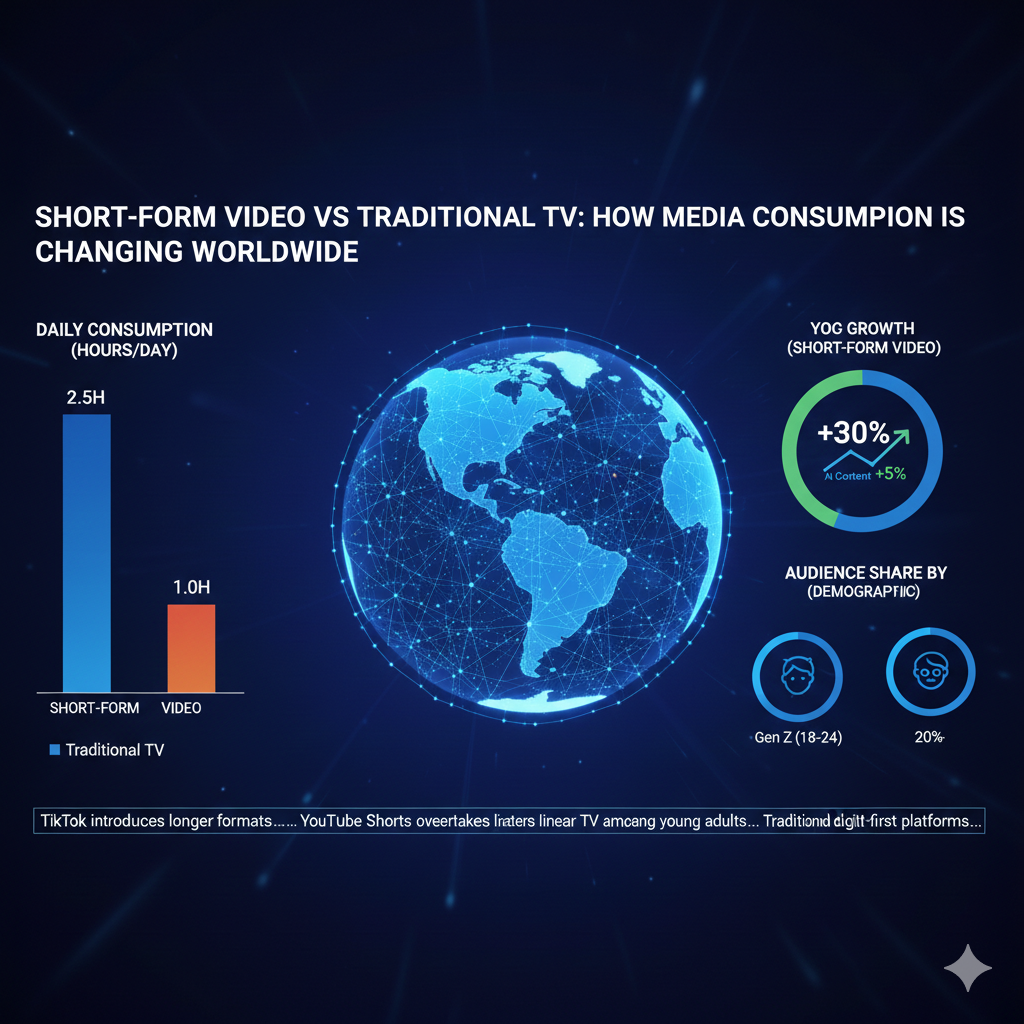
The way the world watches content has fundamentally changed. For decades, the television set was the undisputed hearth of the modern home—a centralized device where families gathered at specific times to watch scheduled programming. Today, that singular focal point has fractured into billions of glowing rectangles in pockets, purses, and hands across the globe.
The rise of short-form video is not merely a trend; it is a structural evolution in how information and entertainment are produced, distributed, and consumed. Platforms like TikTok, Instagram Reels, and YouTube Shorts have conditioned audiences to expect content that is immediate, vertically oriented, and algorithmically curated. Meanwhile, traditional television—though often declared “dead” by alarmists—remains a powerful force, particularly for live events and premium storytelling.
This shift presents complex challenges and opportunities for advertisers, creators, and media conglomerates. Understanding the nuances between these two formats is essential for anyone navigating the current media landscape. This analysis explores the technological, demographic, and behavioral drivers behind the migration from the living room to the mobile screen, and what the future holds for global media consumption.
What Is Short-Form Video?
Short-form video generally refers to content ranging from a few seconds to three minutes in duration. Unlike traditional television or even standard YouTube videos, this format is designed primarily for mobile devices, often displayed in a 9:16 vertical aspect ratio.
The explosion of this medium is inextricably linked to the ubiquity of smartphones. As mobile internet speeds improved and data became more affordable globally, video consumption moved out of the living room and into transit commutes, coffee breaks, and bedroom scrolling sessions. Platforms like Vine (now defunct) and Musical.ly (the precursor to TikTok) pioneered the format, but it was the algorithmic sophistication of modern apps that turned short-form video into a dominant global pastime.
These platforms prioritize “snackable” content—videos that deliver a punchline, a tutorial, or a visual spectacle instantly. The barrier to entry for creators is low; a smartphone and basic editing tools are often sufficient to reach millions of viewers. This democratization of content creation stands in stark contrast to the high-production, gatekept world of traditional television.
Traditional TV vs Digital Media: A Global Shift
For over half a century, “watching TV” meant tuning into a broadcast signal or cable feed at a predetermined time. This model, known as linear TV, created shared cultural moments but offered viewers little control. The digital revolution introduced on-demand viewing, first through DVRs and later through streaming services (SVOD).
While streaming services like Netflix and Disney+ bridged the gap between linear TV and digital flexibility, short-form video represents a more radical departure. It creates a lean-back experience that mimics the passivity of traditional TV but offers the personalization of the internet.
The decline of linear TV viewing is measurable in almost every major market. Cord-cutting—the practice of canceling cable subscriptions in favor of internet-based alternatives—has accelerated in North America and Europe. However, in many emerging markets, mobile-first video isn’t replacing TV; it’s often the first and primary screen for entertainment. This leapfrog effect means that for millions of people, “TV” as a concept is secondary to the infinite scroll of a social feed.
Why Short-Form Video Is Growing Worldwide
Several converging factors drive the rapid adoption of short-form content. It is not just about shorter attention spans, but rather a realignment of how value is delivered to the viewer.
Changing Attention Spans
The modern digital environment is incredibly noisy. Users are bombarded with notifications, emails, and messages. In this context, content that requires a significant time investment faces higher friction. Short-form video respects the viewer’s time by promising a complete narrative arc or payoff in under sixty seconds. This “bite-sized” consumption fits seamlessly into the fragmented schedule of modern life. A user might not have 45 minutes to watch a drama episode during a commute, but they have time to watch twenty 2-minute clips.
Social Media Algorithms
Perhaps the most significant driver is the shift from the “social graph” to the “interest graph.” Early social media showed you content from people you followed (your social graph). Modern short-form platforms use sophisticated AI to show you content you might like, regardless of who created it (your interest graph).
These algorithms analyze watch time, re-watches, and engagement to build a hyper-personalized feed. This creates a feedback loop where the platform constantly learns and refines its recommendations, keeping users engaged for longer periods than traditional linear programming often can.
Creator Economy Expansion
The traditional TV model relies on studios, scriptwriters, and casting directors. The short-form model relies on the global population. The “Creator Economy” has empowered individuals to build massive audiences without traditional gatekeepers.
This user-generated content (UGC) feels authentic and relatable. A cooking tip from a home chef or a comedy skit filmed in a bedroom often resonates more with younger audiences than polished, studio-produced segments. This vast supply of diverse content ensures that there is always something new to watch, catering to niche interests that mass-market television simply cannot serve.
How Traditional TV Is Adapting
Traditional broadcasters are not standing still. Recognizing the threat, many major networks and studios are adopting hybrid strategies.
First, there is the integration of streaming. Most major broadcast networks now operate their own streaming platforms or license content to aggregators. They are also experimenting with “FAST” channels (Free Ad-Supported Streaming TV), which recreate the linear TV experience in a digital environment.
Second, traditional media is borrowing the aesthetic and pacing of short-form video. News segments are becoming shorter and more visual. Sports broadcasters are packaging highlights specifically for social media distribution, using short clips to drive viewers back to the live long-form broadcast. This symbiotic relationship acknowledges that short-form video is an excellent discovery engine for long-form content.
Audience Demographics Driving Media Change
The divide between short-form and traditional TV is heavily demarcated by age.
Gen Z and Millennials vs Older Viewers
Data consistently shows that Gen Z and Millennials spend significantly more time on social video platforms than on linear TV. For these cohorts, the smartphone is the primary screen. They value authenticity, interactivity, and on-demand access.
Conversely, older demographics (Gen X and Boomers) remain the stronghold of traditional television. They are more likely to retain cable subscriptions and view TV as a communal evening activity. However, the gap is closing. As older generations become more tech-savvy, their adoption of digital platforms is increasing, albeit at a slower rate.
Mobile vs Living-Room Viewing Habits
The physical context of viewing matters. Traditional TV dominates the living room—a “lean-back” experience often shared with others. Short-form video dominates mobile usage—a private, “lean-forward” experience. Interestingly, we are seeing a convergence here as well. Connected TV (CTV) apps for YouTube and TikTok are bringing short-form content onto the big screen in the living room, attempting to bridge the gap between solitary scrolling and communal viewing.
Advertising and Monetization Differences
The business models underpinning these formats are distinct, presenting different value propositions to advertisers.
Traditional TV commercials are built on the concept of reach and frequency within a specific timeslot. Advertisers pay a premium for prime-time slots to reach a broad, general audience. It is a high-trust environment suitable for brand building.
Short-form video ads are highly targeted and performance-driven. Because platforms know exactly who is watching and what their interests are, advertisers can target niche demographics with precision. Furthermore, the rise of influencer marketing allows brands to integrate their message directly into the content, bypassing the “commercial break” entirely. This native advertising often yields higher engagement rates, though measuring ROI can be complex compared to the standardized metrics of TV ratings.
Content Formats and Storytelling Evolution
The medium dictates the message. Traditional TV excels at long-form storytelling—complex character arcs, slow-building tension, and high-budget production values. Shows like Succession or Game of Thrones require a canvas that short-form cannot provide.
Short-form video has birthed its own narrative grammar. Episodic micro-content allows creators to tell stories in installments, keeping audiences hooked over days or weeks. Visual storytelling techniques, such as quick cuts, text overlays, and trending audio, communicate information rapidly. While it may lack the depth of a prestige drama, short-form storytelling is incredibly efficient at conveying emotion, humor, and information.
Global Media Consumption Trends
The shift to short-form is a global phenomenon, but regional nuances exist.
In Asia, particularly China, the integration of short-form video with e-commerce (social commerce) is far advanced compared to the West. Livestream shopping and seamless in-app purchasing have turned video apps into massive retail engines.
In emerging markets in Africa and Latin America, where mobile data is the primary internet access point, short-form video is often the default entertainment medium. The lower data requirements of short clips compared to HD streaming movies make them more accessible.
Meanwhile, in North America and Western Europe, there is a fragmented ecosystem where high-end subscription streaming coexists with heavy social media usage. Viewers here are often “second-screening”—scrolling through short-form content on their phone while a long-form TV show plays in the background.
Role of Technology in Media Transformation
Technology continues to accelerate these shifts. Artificial Intelligence (AI) is central to the success of short-form platforms, powering the recommendation engines that keep users glued to the screen.
Beyond recommendations, AI is increasingly used in content creation itself. Automated editing tools, AI-generated captions, and even AI-generated video avatars are lowering the barrier to entry further.
Cross-platform viewing experiences are also evolving. Technologies like Chromecast and AirPlay make it effortless to fling content from a phone to a TV. As 5G networks roll out globally, the friction of watching high-quality video on mobile vanishes entirely, removing the last technical advantage of wired cable connections.
Challenges Facing Both Media Formats
Despite the growth, the media landscape is not without significant hurdles.
Content Overload
Viewers are drowning in choice. The sheer volume of content available on both streaming services and social platforms can lead to “decision paralysis.” For short-form platforms, the risk is that the feed becomes a chaotic noise of low-quality content. For streamers, the risk is that users spend more time browsing menus than watching shows.
Subscription Fatigue
The fragmentation of the streaming market has led to subscription fatigue. Consumers are increasingly reluctant to pay for multiple services (Netflix, Hulu, Disney+, HBO, etc.). This economic pressure is pushing audiences toward free, ad-supported alternatives—both in the form of FAST channels and free-to-use social video apps.
Will Short-Form Video Replace Traditional TV?
It is unlikely that short-form video will completely replace traditional TV. Instead, we are moving toward a coexistence model.
History shows that new media rarely completely exterminate old media; they force them to adapt. Radio survived the invention of TV. TV survived the internet. Cinema survived streaming. Each format settles into a specific niche.
Traditional TV (and long-form streaming) will likely remain the home of “event” viewing—sports, awards shows, and premium drama. It serves the need for immersion and communal experience. Short-form video will serve the need for distraction, quick entertainment, and information discovery.
The boundary, however, will continue to blur. TV shows will be edited into TikTok clips to drive traffic. TikTok stars will get TV shows. The ecosystem will become fluid, with IP moving between formats depending on the context.
Future Outlook for Global Media Consumption
The future of media is personalized and interactive. We can expect to see further integration of gaming and video, where viewers can influence the outcome of the content they watch. “Shoppable” video will likely expand from Asia to become a global standard, turning every screen into a point of sale.
Ultimately, the distinction between “TV” and “Short-Form” may become semantic. To the next generation, it is all just “video”—some of it is long, some of it is short, and it is available on whatever screen happens to be closest.
FAQs – Short-Form Video vs Traditional TV
Why is short-form video so popular?
Its popularity stems from its compatibility with mobile lifestyles, algorithmic personalization that shows users exactly what they like, and the low barrier to entry for diverse creators. It fits into small pockets of free time, offering instant gratification.
Is traditional TV declining worldwide?
Linear TV viewership is declining in most developed markets as viewers shift to on-demand streaming and digital platforms. However, it remains stable in some regions and continues to be the preferred format for live sports and major news events.
Which format attracts younger audiences?
Gen Z and younger Millennials predominantly favor short-form video and social media platforms. They are “mobile-first” natives who value authenticity and creator-driven content over high-production studio programming.
How are advertisers adapting to media shifts?
Advertisers are diversifying their spend. While TV is still used for broad brand awareness, budgets are shifting toward digital and influencer marketing to target specific demographics more effectively and measure performance with granular data.
Will long-form content disappear?
No. Long-form content provides depth, character development, and immersive storytelling that short-form cannot replicate. The delivery method may change (from cable to streaming), but the human desire for substantial stories remains strong.


