




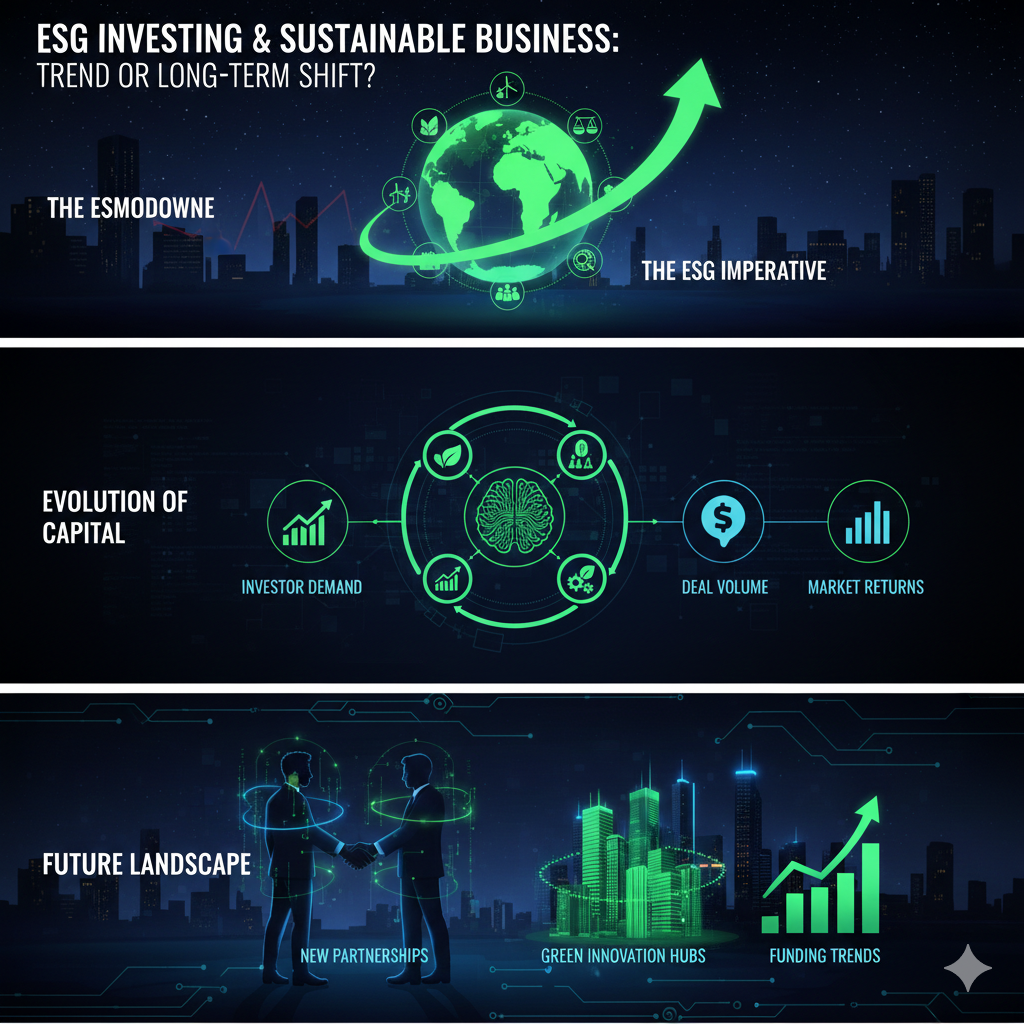
For decades, the primary objective of the corporation was simple: maximize shareholder value. Profit was the only metric that truly mattered. However, the financial landscape has undergone a significant transformation in recent years. Assets under management in funds that prioritize Environmental, Social, and Governance (ESG) factors have surged into the trillions, signaling a potential reimagining of capitalism itself.
This rise has forced CEOs, investors, and entrepreneurs to confront a difficult question. Is the push toward sustainable business a fundamental structural shift in how markets operate, or is it merely a marketing trend destined to fade when economic conditions tighten?
The answer affects everything from capital allocation to supply chain management. Understanding the mechanics, opportunities, and legitimate risks of ESG is no longer optional for global business leaders. It is now a critical component of strategic planning and risk management.
What Is ESG Investing?
At its core, ESG investing is a strategy that accounts for environmental, social, and corporate governance factors alongside traditional financial metrics. It operates on the premise that these non-financial factors have a material impact on a company’s long-term performance and risk profile.
Environmental, Social, and Governance basics
The framework breaks down into three distinct pillars:
- Environmental: This assesses how a company performs as a steward of nature. It includes energy usage, waste management, pollution output, and resource depletion. For many investors, carbon footprint and climate risk are the dominant metrics here.
- Social: This examines how a company manages relationships with employees, suppliers, customers, and the communities where it operates. It covers labor standards, diversity and inclusion, data protection, and human rights.
- Governance: This deals with a company’s leadership, executive pay, audits, internal controls, and shareholder rights. Good governance ensures the company is run responsibly and transparently.
ESG vs traditional investing approaches
Traditional investing focuses almost exclusively on the financial statement—balance sheets, cash flow, and P&L. If a company is profitable and legal, it is deemed a good investment.
ESG investing adds a layer of screening. An ESG investor might look at a profitable chemical manufacturer and pass on the investment because the company faces high litigation risks due to pollution (Environmental) or has a board lacking independence (Governance). The argument is not just ethical; it is financial. ESG proponents argue that ignoring these externalities blinds investors to long-term risks.
Why ESG Investing Has Gained Momentum
The rapid ascent of sustainable investing is not accidental. It is the result of converging global pressures that have made “business as usual” riskier than before.
Tangible environmental changes have moved climate risk from a theoretical problem to a balance sheet liability. Extreme weather events disrupt supply chains and damage physical assets, forcing markets to price in these risks. Simultaneously, social movements regarding labor rights and equality have pressured corporations to take stands on public issues, linking brand value directly to corporate values.
Investor demand for transparency
A demographic shift in wealth is also driving this change. Millennials and Gen Z investors, who are beginning to inherit significant capital, are statistically more likely to demand that their portfolios align with their values. They require transparency not just on how much money a company makes, but how that money is made.
ESG Investing: Trend or Structural Shift?
Skeptics often dismiss ESG as a bull-market luxury—something investors care about only when returns are easy. However, the data suggests a deeper entrenchment.
Short-term hype vs long-term strategy
There is undeniable hype. Marketing departments have aggressively slapped “green” labels on products, and the media cycle often inflates the immediate impact of sustainability initiatives. However, beneath the marketing noise, the machinery of finance is changing. Insurance companies are recalculating premiums based on climate models. Banks are stress-testing loan portfolios against carbon transition scenarios.
Institutional adoption trends
The strongest evidence for a structural shift comes from institutional investors. Sovereign wealth funds, pension funds, and massive asset managers are integrating ESG criteria into their mandates. When the world’s largest pools of capital require sustainability reporting, it ceases to be a trend and becomes a market standard.
Key Drivers Behind Sustainable Business Growth
Three powerful forces are pushing ESG from the periphery to the center of global business strategy.
Regulatory Pressure and Reporting Standards
Governments are moving from voluntary guidelines to mandatory disclosures. The European Union’s Corporate Sustainability Reporting Directive (CSRD) creates strict obligations for companies to report on their environmental and social impact. In the United States, the SEC has moved toward requiring climate-related disclosures. Compliance is no longer about PR; it is a legal necessity.
Consumer Preferences for Ethical Brands
Consumers are increasingly voting with their wallets. Studies consistently show that a significant portion of the market is willing to pay a premium for sustainable goods or switch brands based on ethical concerns. This links sustainability directly to revenue growth and customer retention.
Capital Allocation and Investor Expectations
The cost of capital is changing. Companies with strong ESG ratings often enjoy better access to financing, known as the “greenium” (green premium). Conversely, businesses with poor environmental records or weak governance may find their pool of potential investors shrinking, driving up their borrowing costs.
Benefits of ESG Investing
While the moral arguments for ESG are clear, the business case relies on resilience and risk mitigation.
Risk management and governance
ESG is, fundamentally, a risk management tool. A company that ignores water scarcity risks in its supply chain is vulnerable to operational shutdowns. A company with poor labor practices is vulnerable to strikes and reputation-damaging scandals. By monitoring these factors, investors and executives can identify “blind spots” that traditional financial analysis might miss.
Long-term brand and operational resilience
Sustainable businesses tend to build more resilient operations. Energy-efficient operations lower utility costs. Strong employee relations reduce turnover and recruitment costs. Over time, these efficiencies compound, potentially creating a competitive moat that protects the business during economic downturns.
Criticisms and Challenges of ESG
Despite the momentum, the ESG movement faces valid criticism and significant hurdles that investors must navigate.
Greenwashing concerns
The single biggest threat to the credibility of ESG is greenwashing—the practice of making misleading or unsubstantiated claims about the environmental benefits of a product or practice. When companies exaggerate their sustainability efforts to attract capital, it undermines trust in the entire sector. Regulators are increasingly cracking down on this, but it remains a pervasive issue.
Inconsistent ESG metrics
Unlike financial accounting, which follows generally accepted principles (GAAP or IFRS), ESG accounting is still the “Wild West.” Different rating agencies can give the same company vastly different scores because they weight factors differently. One agency might prioritize carbon emissions, while another prioritizes labor unions. This lack of standardization makes it difficult for investors to compare apples to apples.
ESG’s Impact Across Major Industries
The application of ESG varies wildly depending on the sector.
Energy and renewables
The energy sector is at the epicenter of the transition. Oil and gas majors are under immense pressure to diversify into renewables or prove they can decarbonize their operations. For these companies, ESG is an existential challenge regarding their future business model.
Technology and manufacturing
For the tech sector, the “E” involves the massive energy consumption of data centers, but the “S” and “G” are often more prominent. Issues regarding data privacy, AI ethics, and board diversity are central. In manufacturing, the focus is heavily on supply chain integrity and waste reduction.
Consumer goods and retail
Here, the focus is often on the circular economy—reducing plastic packaging, ensuring ethical sourcing of raw materials, and managing the end-of-life of products. Brand reputation in this sector is highly sensitive to labor controversies in the supply chain.
Financial Performance Debate
Does ESG investing actually generate higher returns? This is the most debated question in the industry.
ESG returns vs traditional portfolios
Research has produced mixed results. During the technology boom, ESG funds outperformed because they were overweight in tech and underweight in energy. Conversely, when oil prices spiked, traditional energy-heavy portfolios outperformed.
However, over longer horizons, meta-studies suggest that companies with strong ESG propositions do not underperform the market and often exhibit lower volatility.
Market perception and reality
The market perception has shifted from “ESG means sacrificing returns” to “ESG means quality.” High ESG scores often correlate with high-quality management teams. If a company is meticulous about its energy use and waste, it is likely meticulous about its capital allocation and operations as well.
Role of Technology in Sustainable Business
Technology is the enabler that will allow ESG to mature from vague promises to concrete data.
Data tracking and ESG analytics
AI and big data are revolutionizing how investors track sustainability. Satellite imagery can verify reforestation claims or spot methane leaks. Natural language processing can scan thousands of news sources to detect sentiment regarding a company’s labor practices. This moves ESG ratings from self-reported surveys to objective data.
Supply chain transparency
Blockchain technology offers the potential for immutable supply chain tracking. This allows companies to prove the origin of their raw materials, ensuring that no forced labor or illegal deforestation is involved in their products.
Global Policy Trends Affecting ESG Investing
The political environment for ESG is fragmenting.
Climate regulations
Europe continues to lead with strict taxonomies defining what counts as “green.” This creates a regulatory moat for EU businesses but also high compliance costs. Asia is catching up, with China and Japan setting aggressive decarbonization targets.
International sustainability frameworks
Efforts are underway to globalize standards. The International Sustainability Standards Board (ISSB) is working to create a global baseline for sustainability reporting, similar to how IFRS standardized financial reporting. This harmonization is essential for global capital flows.
Future Outlook for ESG and Sustainable Business
Looking ahead, the label “ESG” might disappear, but the practice will likely become ubiquitous.
Integration into mainstream investing
The future of ESG is likely integration, not separation. Rather than having specific “ESG funds,” standard equity funds will simply incorporate these factors into their routine analysis. It will become negligent to analyze a coastal real estate company without modeling sea-level rise, just as it would be negligent to ignore their debt levels.
Evolution of sustainability standards
We can expect a shakeout in the rating agency industry, leading to fewer, more rigorous standards. As data improves, greenwashing will become harder to hide, and the market will become efficient at pricing in environmental and social risks.
FAQs – ESG Investing and Sustainability
What does ESG investing mean?
ESG investing is a strategy that considers Environmental, Social, and Governance factors alongside financial factors in the investment decision-making process.
Is ESG investing profitable long term?
While past performance is no guarantee of future results, studies suggest that ESG investments perform competitively with traditional investments and may offer better downside protection during market volatility.
Why is ESG controversial?
Critics argue that it can distract from shareholder returns, that the data is inconsistent, and that it can be used for “greenwashing.” In some regions, it has also become a politically polarized topic.
Are companies required to follow ESG rules?
It depends on the jurisdiction. The EU has mandatory reporting requirements. Other regions, like the US, are moving toward mandatory climate disclosures, but many aspects remain voluntary.
Will ESG remain important in future markets?
Yes. While the terminology may evolve, the underlying drivers—resource scarcity, climate risk, and social transparency—are long-term structural issues that businesses and markets cannot ignore.
Preparing for a Sustainable Economy
The debate over whether ESG is a trend or a shift is largely settled by the flow of capital. When trillions of dollars move based on sustainability criteria, the shift becomes reality. For entrepreneurs and investors, the challenge is no longer deciding if they should care about ESG, but how to implement it effectively.
The winners of the next decade will likely be those who view sustainability not as a compliance burden, but as an opportunity for efficiency, innovation, and deeper connection with their customers.


