




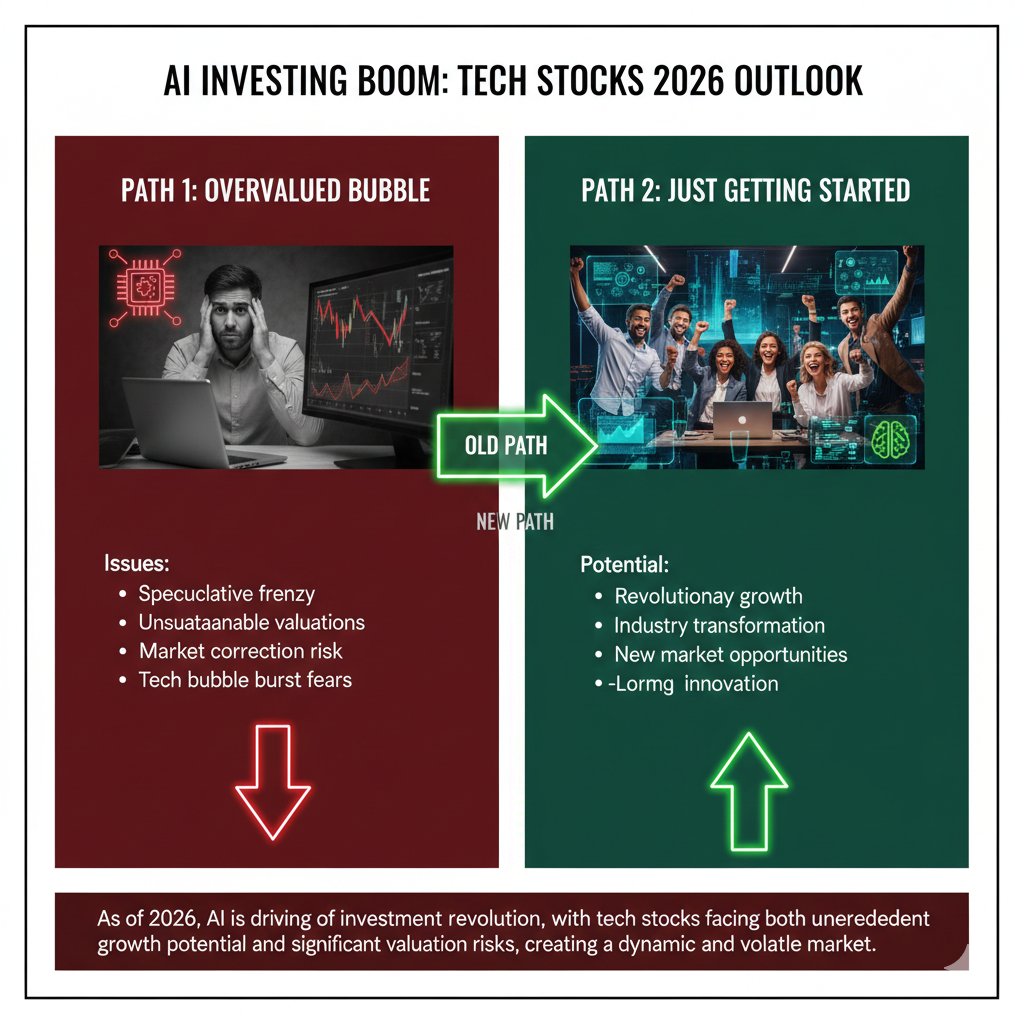
Artificial intelligence has rapidly shifted from science fiction to the central driver of modern financial markets. Since the public debut of generative AI tools, global stock exchanges have seen a surge in capital flowing toward technology companies. This influx has pushed valuations of chipmakers, cloud providers, and software giants to historic highs, leaving investors asking a critical question: Is this the start of a long-term technological revolution, or are we witnessing another market bubble?
Understanding the dynamics of the AI investing boom requires looking beyond the hype. It involves analyzing how interest rates, corporate earnings, and global economic shifts influence stock prices. This article explores the fundamental drivers behind the current tech rally, compares the current landscape to previous market cycles, and breaks down the arguments for and against current valuations.
What Is the AI Investing Boom?
The “AI investing boom” refers to the rapid appreciation in the stock prices of companies associated with artificial intelligence. This trend began accelerating significantly in late 2022 and early 2023, driven by breakthroughs in generative AI—technology capable of creating text, images, and code.
Historically, technology sectors often experience waves of intense investment. The personal computer era, the rise of the internet, and the mobile smartphone revolution all triggered similar patterns. In the current cycle, capital is concentrating on three main areas:
- Hardware: The physical infrastructure, such as semiconductors and data centers, required to train and run AI models.
- Infrastructure: Cloud computing platforms that host AI applications.
- Applications: Software companies integrating AI features to enhance productivity or consumer experiences.
This market movement is not limited to a single country. While Silicon Valley remains a hub, semiconductor manufacturing in Taiwan and software development in Europe and Asia are also attracting significant investment. The scale of capital expenditure suggests that corporations view AI not as a temporary trend, but as a fundamental shift in how business is conducted.
Why Investors Are Betting Big on AI
The enthusiasm for AI stocks stems from the belief that this technology will radically alter the global economy. Investors are pricing in massive future growth based on two primary factors: productivity gains and enterprise adoption.
Productivity Gains and Automation
Economists and analysts project that AI could significantly boost labor productivity. By automating routine cognitive tasks—such as coding, data entry, and customer service—companies can potentially increase output without a proportional increase in costs. In financial theory, higher productivity leads to higher profit margins. Investors buy stocks today in anticipation of these higher future profits.
Enterprise Adoption and Global Demand
Unlike consumer fads, the current AI wave is heavily driven by business-to-business (B2B) spending. Major corporations across healthcare, finance, and logistics are integrating AI to streamline operations. This creates a sustained demand for the technology. For example, a bank using AI to detect fraud more quickly or a pharmaceutical company using it to speed up drug discovery represents tangible, high-value use cases that support long-term revenue growth for tech providers.
Are Tech Stocks Overvalued in 2026?
Determining if a stock is “overvalued” is one of the most difficult tasks in finance. It requires comparing the current price of a stock to the actual financial value the company generates.
Valuation Metrics Explained
The most common metric used to gauge value is the Price-to-Earnings (P/E) ratio. This ratio compares a company’s current stock price to its earnings per share (profit).
- A low P/E ratio generally suggests a stock is cheap or undervalued.
- A high P/E ratio suggests a stock is expensive, implying that investors expect high growth in the future.
In the context of AI, many tech companies currently have very high P/E ratios. Investors are willing to pay a premium today because they expect these companies to double or triple their profits in the coming years. If those profits fail to materialize, the stock price is likely to fall, indicating the stock was indeed overvalued.
Historical Tech Bubble Comparisons
Market analysts frequently compare the AI boom to the “Dot-com Bubble” of the late 1990s. During that period, investors poured money into any company with a “.com” in its name, regardless of whether the company made a profit. When the bubble burst, valuations crashed.
However, there is a key difference today. The primary beneficiaries of the AI boom are often established, highly profitable mega-cap companies with massive cash reserves. Unlike the speculative startups of 1999, today’s AI leaders are already generating billions in revenue, which provides a stronger financial floor for their valuations.
Market Sentiment and Momentum
Stock prices are driven by psychology as much as math. “Momentum investing” occurs when investors buy stocks simply because the price is rising, hoping to sell at a higher price later. This creates a feedback loop that can detach prices from fundamentals. Both retail investors (individuals trading from home) and institutional investors (pension funds and hedge funds) play a role here. High levels of excitement, or “FOMO” (Fear Of Missing Out), can push valuations into overvalued territory, even for strong companies.
Key Sectors Driving AI Stock Growth
The AI ecosystem is broad, but investment flows are currently channeled into specific bottlenecks in the supply chain.
Semiconductors and Hardware
The “picks and shovels” of this gold rush are the microchips. AI models require massive computational power to process data. Companies that design and manufacture Graphics Processing Units (GPUs) and specialized AI accelerators have seen the most explosive growth. Without these advanced chips, modern AI cannot function. Consequently, the semiconductor sector has become a primary proxy for AI growth.
Cloud Computing Platforms
AI models live in the cloud. They require vast data centers to store information and run calculations. The major providers of cloud infrastructure are benefiting as businesses rent computing power to build their own AI applications. These platforms act as the utility companies of the AI age, charging for the electricity and infrastructure needed to run the new digital economy.
Software and AI Infrastructure
Beyond the hardware, there is a layer of software companies building the tools to manage AI. This includes cybersecurity firms protecting AI data, database companies organizing the information, and application developers creating user-friendly interfaces. As AI becomes standard in office suites and creative tools, software companies that successfully monetize these features are seeing their stock prices rise.
Role of Big Tech in the AI Investment Narrative
The current market rally is notably top-heavy. A small group of massive technology companies contributes a disproportionate amount of the overall market gains.
Platform Dominance
Big Tech companies possess a distinct advantage: data. Training AI models requires immense amounts of data, which these platforms have collected for decades. They also have the existing user bases to distribute AI tools instantly. For instance, a search engine or social media platform can roll out an AI update to billions of users overnight, a distribution power that startups cannot match.
Capital Spending and Innovation Race
Developing frontier AI models costs billions of dollars. Only the largest tech companies have the balance sheets to support this level of capital expenditure (CapEx). They are purchasing the majority of the available high-end chips and building the largest data centers. This spending creates a “moat,” making it difficult for smaller competitors to catch up, which reinforces investor confidence in the giants.
Risks Facing AI-Focused Tech Stocks
While the growth narrative is strong, significant risks could derail the current upward trajectory.
Regulation and Policy Uncertainty
Governments worldwide are scrutinizing AI development. Potential regulations regarding data privacy, copyright infringement, and national security could increase costs or limit how companies can deploy AI. For example, export controls on advanced chips restrict sales to certain markets, directly impacting revenue for hardware manufacturers.
Competition and Rapid Innovation Cycles
The pace of innovation in AI is blistering. A company that leads the market today could be obsolete in 18 months if a competitor releases a more efficient model or a cheaper chip. This “technological obsolescence” risk makes picking long-term winners difficult. Hardware that is cutting-edge today may become a commodity tomorrow, squeezing profit margins.
Market Volatility
Tech stocks are inherently more volatile than utility or consumer staple stocks. They are sensitive to changes in market sentiment. If an AI leader misses an earnings target or issues a cautious forecast, the stock can drop significantly in a single day. This volatility poses a risk for investors with short time horizons.
Long-Term Growth Arguments for AI Investing
Proponents of the AI boom argue that we are in the early stages of a multi-decade transformation.
Productivity Transformation
The bull case rests on the idea that AI is a “General Purpose Technology,” similar to electricity or the steam engine. If AI can truly automate complex tasks, it could lead to an era of hyper-productivity. This would expand the total size of the global economy, allowing companies to grow revenues faster than expenses, justifying higher stock valuations over the long term.
New Business Models and Revenue Streams
AI enables new ways to make money. We are seeing the rise of “Model-as-a-Service,” where companies pay subscription fees to access AI capabilities. Furthermore, AI could unlock breakthroughs in genomics, materials science, and clean energy, creating entirely new industries that do not exist today. Investors buying now are betting on these future, yet-to-be-defined revenue streams.
AI Investing vs Previous Tech Waves
Contextualizing the current boom against history provides a clearer picture of market maturity.
Dot-com Era vs Modern AI Ecosystem
During the Dot-com boom, companies were valued on “eyeballs” (website visitors) rather than revenue. Today, the companies driving the AI rally have robust cash flows and enormous profits. The financial health of the sector is fundamentally stronger than it was in 2000.
Infrastructure Maturity
When the internet started, the infrastructure (fiber optic cables, broadband) had to be built from scratch. Today, the internet infrastructure is mature. AI is being deployed over existing high-speed networks to devices that everyone already owns. This allows for much faster adoption rates compared to previous technological shifts, potentially accelerating the return on investment.
How Macroeconomic Factors Influence Tech Valuations
Stock prices do not move in a vacuum. They are heavily influenced by the broader economic environment, particularly interest rates set by central banks.
Interest Rates and Liquidity
There is an inverse relationship between interest rates and tech stock valuations.
- Low Interest Rates: When rates are low, borrowing money is cheap. This encourages companies to invest in growth and makes risky assets (like tech stocks) more attractive than safe bonds.
- High Interest Rates: When rates rise, borrowing becomes expensive. This hurts “growth stocks” because their future cash flows are worth less in today’s dollars (a concept known as discounting).
If central banks keep rates high to fight inflation, it acts as a headwind for tech valuations. Conversely, if rates fall, it generally acts as rocket fuel for the sector.
Economic Growth Expectations
Tech spending is cyclical. If the global economy enters a recession, businesses usually cut their IT budgets. This reduces revenue for software and cloud companies. Therefore, the sustainability of the AI boom depends partially on a healthy global economy that allows businesses to continue investing in new tools.
What Analysts and Investors Are Watching
To determine where the market is heading, professional investors monitor specific indicators.
Earnings Growth
Hype eventually meets reality in quarterly earnings reports. Investors are watching to see if the massive spending on AI hardware is actually translating into profit for the companies buying it. If companies spend billions on chips but don’t see a return on investment, spending will slow down, hurting the hardware manufacturers.
AI Adoption Metrics
Analysts track how quickly users and businesses are adopting new tools. Metrics like “Monthly Active Users” for AI chatbots or “Annual Recurring Revenue” for AI software give insight into whether the technology is sticking or if interest is fading.
Capital Expenditure Trends
The amount Big Tech companies spend on infrastructure is a leading indicator. If CapEx remains high, it signals confidence in future demand. If CapEx begins to flatten or drop, it may signal that the initial build-out phase is ending, which could slow growth for chipmakers.
Bull Case vs Bear Case for AI Stocks
To summarize the market debate, here are the opposing views dominating financial discussions.
Bullish Arguments
The bulls argue that we are witnessing a structural technology shift. They believe AI will permeate every sector of the economy, leading to efficiency gains that justify even higher valuations. They argue that looking at past P/E ratios is misleading because AI will allow companies to generate profits at a scale never before seen.
Bearish Arguments
The bears argue that the market is driven by overhyped narratives. They believe that while AI is real, the financial benefits will take much longer to materialize than investors expect. They warn that capital spending is unsustainable and that once the initial excitement fades, valuations will revert to historical averages, causing significant losses for latecomers.
FAQs – AI Investing and Tech Stock Valuations
Are AI stocks overvalued right now?
There is no single answer. By historical standards (P/E ratios), many AI stocks appear expensive. However, if these companies achieve the massive growth rates that analysts project, they could grow into their valuations. It depends on whether you believe the optimistic earnings forecasts.
What drives tech stock valuations?
Valuations are driven by a combination of current earnings, expected future growth, interest rates, and market sentiment. In the tech sector, “future growth” is often the most heavily weighted factor.
Is AI a long-term investment trend?
Most industry experts believe AI is a long-term trend comparable to the internet or cloud computing. However, a long-term trend does not guarantee that stock prices will go up in a straight line. There will likely be periods of volatility and correction along the way.
Can AI stocks grow without a bubble?
Yes, but it requires earnings to grow as fast as stock prices. If a company’s stock price doubles, its profits ideally should double as well to maintain a stable valuation. A bubble occurs when prices rise significantly faster than the underlying profits.
What risks should investors consider?
Investors should consider regulatory risks, the impact of high interest rates, competition, and the possibility that AI adoption may be slower than the market currently anticipates. Diversification remains a key strategy to manage these risks.
The AI investing boom represents a complex intersection of cutting-edge technology and global economics. While the potential for transformation is undeniable, the financial markets rarely move in a perfectly rational line. Whether tech stocks are overvalued or just getting started depends on the interplay between productivity gains, interest rates, and corporate execution in the coming years. For investors, separating the technological reality from the market noise remains the ultimate challenge.


