




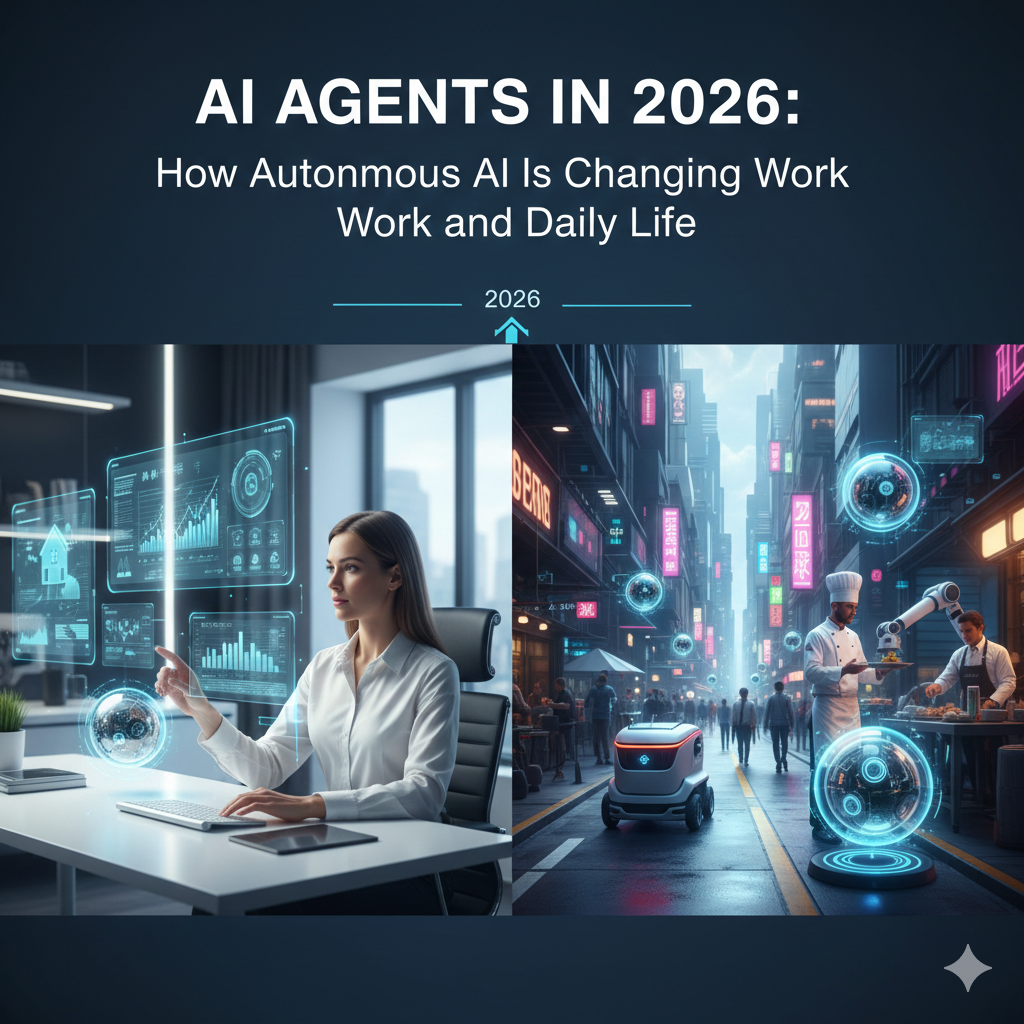
The concept of artificial intelligence has shifted dramatically over the last few years. We moved from simple chatbots that could barely understand a “hello” to sophisticated Large Language Models (LLMs) capable of writing poetry and debugging code. Now, in 2026, we are witnessing the next major evolution: the era of the AI agent.
Unlike the passive AI tools of the early 2020s—which waited for a human prompt to generate text or images—AI agents are active. They are autonomous software entities designed to perceive their environment, reason through complex problems, and take action to achieve specific goals without constant human intervention.
For businesses and individuals alike, this shift from “chatting with AI” to “delegating to AI” is transforming how we approach productivity. This guide explores how autonomous AI agents are reshaping industries, the benefits they offer, and the critical challenges we must navigate as they become integral to our daily lives.
What Are AI Agents?
To understand the impact of AI agents, we must first define what they are. An AI agent is a software program capable of autonomous action. It doesn’t just process information; it uses tools, accesses the internet, and interacts with other software to complete multi-step tasks.
Defining Autonomous AI
The core characteristic of an AI agent is agency. While a standard LLM might tell you how to book a flight, an AI agent can actually go to the travel site, select the flight based on your preferences, enter your details, and send you the confirmation. It operates in a loop: perceive, think, act, and learn.
AI Agents vs. Traditional Automation
Traditional automation (like Zapier or simple scripts) follows a rigid set of rules: “If X happens, do Y.” If an unexpected variable occurs, the automation breaks.
AI agents, however, are dynamic. They can handle ambiguity. If an agent tries to book a meeting and finds a conflict, it can reason through the problem, propose alternative times, or check the priority of the conflicting event—much like a human assistant would. They adapt to the situation rather than just following a pre-written script.
Why AI Agents Are Growing Rapidly in 2026
The explosion of AI agents isn’t accidental. It is the result of converging technologies that have matured significantly over the last few years.
Advances in Machine Learning and Natural Language Tools
The underlying models powering these agents have become faster, cheaper, and more accurate. Early iterations struggled with “hallucinations” or getting stuck in loops. Today’s models have better reasoning capabilities and larger context windows, allowing them to remember long strings of instructions and maintain coherence over extended tasks.
Demand for Productivity and Efficiency
The modern workplace is often bogged down by administrative overhead. Professionals spend hours on scheduling, data entry, and email triage. There is an immense economic incentive to offload these cognitive but repetitive tasks to software, freeing up humans for high-value creative and strategic work.
How AI Agents Are Transforming Workplaces
The integration of autonomous agents is most visible in the corporate world, where efficiency translates directly to the bottom line.
Task Automation and Workflow Management
In 2026, project management tools often come with built-in agents. Instead of manually updating a Trello board or Asana task, a team member might say, “Update the project status based on the latest commit and notify the design team.” The agent reads the code update, moves the card, and sends a Slack message to the relevant channel, all without human input.
AI Assistants for Professionals
Specialized agents are becoming standard for specific roles:
- Developers: Coding agents don’t just autocomplete syntax; they can write unit tests, identify bugs, and even suggest architectural improvements across a codebase.
- Marketers: Marketing agents can monitor social media trends, draft content variations, and schedule posts across platforms, adjusting the strategy based on real-time engagement data.
- Customer Support: Support agents now handle complex refunds or technical troubleshooting autonomously, only escalating to humans when emotional nuance or policy exceptions are required.
Decision Support and Analytics
Business intelligence has moved beyond static dashboards. AI agents now proactively monitor data streams. A retail business might use an inventory agent that notices a spike in demand for a specific product. Instead of just reporting the spike, the agent could draft a reorder form for the supplier and alert the logistics manager to approve it, drastically reducing reaction time.
AI Agents in Daily Life
While enterprise applications drive the market, AI agents are quietly revolutionizing our personal lives as well.
Personal Productivity Assistants
The “executive assistant” is no longer a luxury reserved for CEOs. Personal AI agents manage family calendars, book dentist appointments, and even negotiate bills. Imagine an agent that notices your internet subscription is about to renew at a higher rate, calls the provider, and negotiates a discount based on competitor pricing—all while you are at work.
Smart Home and Digital Lifestyle Integration
Smart homes are finally becoming “smart.” Instead of manually setting routines, home agents learn your habits. An agent might lower the blinds and turn on the AC because it checked the weather forecast and knows you prefer a cool room when you return from your jog. It integrates with grocery apps to order milk because it tracked your consumption patterns, not because you explicitly told it to.
Benefits of Autonomous AI
The adoption of AI agents is driven by tangible benefits that improve quality of life and business outcomes.
Time Savings and Efficiency Gains
The most immediate benefit is time. By delegating the “drudgery” of digital life—scheduling, filing, researching—humans reclaim hours every week. This shift allows for a focus on “deep work,” creative endeavors, or simply more leisure time.
Personalized Digital Experiences
Agents offer a level of personalization previously impossible. Because they “know” your preferences, history, and goals, they curate information specifically for you. A news agent doesn’t just show top headlines; it summarizes stories relevant to your investments and hobbies, filtering out the noise.
Risks and Challenges of AI Agents
Despite the optimism, the widespread deployment of autonomous software introduces significant risks that society is currently grappling with.
Privacy and Data Security Concerns
To function effectively, an agent needs access—to your email, your calendar, your bank account, and your Slack messages. This creates a massive attack surface. If a malicious actor compromises a personal AI agent, they don’t just get data; they get the ability to act on your behalf. Ensuring robust encryption and permission protocols is the primary security challenge of 2026.
Over-Reliance on Automation
There is a genuine risk of “skill atrophy.” If an agent always schedules meetings, drafts emails, and summarizes reports, junior employees may lose the opportunity to learn these foundational skills. Furthermore, if the system fails, organizations heavily reliant on agents may find themselves paralyzed, unable to execute basic workflows manually.
AI Agents and the Future of Jobs
The conversation around AI and employment remains complex and nuanced.
Augmentation vs. Replacement Debate
The prevailing view in 2026 is one of augmentation. Agents are viewed as “force multipliers.” A single graphic designer equipped with design agents can produce the volume of work previously requiring a team of three. While this increases output, it raises questions about entry-level roles. If the “grunt work” is done by AI, where do interns learn the ropes?
New Roles Emerging Around AI Management
New job titles are appearing on LinkedIn. “Agent Orchestrators” and “AI Workflow Architects” are professionals who specialize in designing, deploying, and maintaining ecosystems of AI agents. Managing a fleet of digital workers is becoming as important a skill as managing human teams.
Industries Most Impacted by AI Agents
While every sector feels the ripples, three industries are undergoing radical transformation.
Technology and Software
Software development cycles have accelerated. Agents handle documentation, testing, and deployment, allowing engineers to ship features faster. This has lowered the barrier to entry for building software, leading to a boom in niche SaaS products.
Finance and Customer Service
In finance, agents perform real-time fraud detection and automated trading with speed unmatched by humans. In customer service, the “wait time” is becoming obsolete as infinite instances of support agents can spin up to meet demand instantly.
E-commerce and Content Creation
E-commerce is shifting from search-based to agent-based. Instead of browsing a catalog, a user asks their shopping agent to “Find a blue winter coat under $200 with high sustainability ratings.” The agent scours the web and presents the best options. This changes how brands must optimize their products for discovery.
Role of AI Agents in Remote Work and Collaboration
As remote work stabilizes as a permanent fixture, agents are the glue holding distributed teams together.
Automated Project Management
Agents act as the central nervous system for remote teams. They ensure that a developer in Tokyo and a product manager in New York are aligned. They automatically transcribe meetings, extract action items, and assign them to the correct people in the correct time zones.
AI-Driven Communication Tools
Communication agents help bridge cultural and linguistic gaps. Real-time translation and tone-checking agents ensure that messages are clear and polite, reducing misunderstandings in global teams.
Regulation and Ethical Questions Around Autonomous AI
With great power comes great regulatory scrutiny. Governments worldwide are racing to establish guardrails.
Transparency and Accountability
If an AI agent makes a mistake—for example, if a trading agent loses millions or a medical agent misdiagnoses a patient—who is responsible? The developer? The user? The AI itself? Establishing liability frameworks is a top priority for legal scholars and policymakers.
Global Policy Discussions
Discussions are moving toward standardizing “Agent IDs”—a way to digitally identify whether an action was taken by a human or a bot. This transparency is crucial for maintaining trust in digital ecosystems.
Future Outlook for AI Agents Beyond 2026
As we look toward the latter half of the decade, the technology shows no signs of slowing down.
Multi-Agent Systems
The next frontier is “multi-agent collaboration.” This involves different specialized agents working together without human coordination. A “research agent” might pass data to a “writer agent,” which then hands a draft to a “legal review agent.” These swarms of specialized software could tackle problems of immense complexity.
Fully Autonomous Workflows
We are moving toward the concept of the “autonomous enterprise,” where entire departments—such as payroll or basic IT support—run with minimal human oversight. The human role shifts entirely to strategy, creativity, and governance.
Taking the Next Step
The era of AI agents is not a distant sci-fi future; it is the reality of 2026. For businesses, the question is no longer if they should adopt these tools, but how to do so safely and effectively. For individuals, the challenge is to master these tools to enhance their own capabilities rather than be overwhelmed by them.
As these autonomous systems integrate deeper into our economy, staying informed and adaptable is the single most valuable skill one can possess.
FAQs – AI Agents in 2026
What is an AI agent?
An AI agent is an autonomous software system that can perceive its environment, reason about how to solve a problem, and take actions to achieve a specific goal. Unlike a standard chatbot, it can use tools and execute tasks without constant human prompting.
How are AI agents different from chatbots?
A chatbot is passive; it waits for you to ask a question and gives an answer. An AI agent is active; it can go out and perform tasks for you, such as booking flights, sending emails, or coding software, often stringing multiple steps together.
Will AI agents replace human jobs?
AI agents are automating many task-based roles, particularly in data entry, scheduling, and basic support. However, they are also creating new roles focused on managing and orchestrating AI. The trend is currently shifting toward augmentation—helping humans do more—rather than total replacement, though entry-level administrative roles are likely to decrease.
Are autonomous AI tools safe to use?
Safety depends on implementation. Risks include data privacy breaches and unintended actions (agents doing things you didn’t want them to do). Using reputable platforms with strong permission controls and “human-in-the-loop” safeguards is essential for safety.
How can businesses adopt AI agents responsibly?
Businesses should start small with low-risk internal workflows, ensure strict data governance, and maintain human oversight for critical decisions. Transparency with employees and customers about where and how AI agents are being used is also vital for ethical adoption.


