


Global Interest Rate Shifts 2026: How Central Banks Are Reshaping the Economy

The global economy operates on a rhythm dictated largely by the cost of money. For businesses, investors, and everyday consumers, that cost is determined by interest rates set by the world’s most powerful financial institutions. As we move through 2026, central banks are navigating a complex landscape of stabilizing inflation, managing growth, and responding to international trade dynamics.
Understanding how these rates work is no longer just for Wall Street analysts. When a central bank in Washington, Frankfurt, or Tokyo adjusts its benchmark rate, the ripple effects are felt in mortgage payments in London, grocery prices in Brazil, and stock portfolios in Singapore. These decisions influence everything from the price of a cup of coffee to the viability of a tech startup.
This guide breaks down the mechanics of interest rate shifts in 2026, explaining the cause-and-effect relationships that drive the global economy. By understanding the tools central banks use and the challenges they face, you can better grasp the financial forces shaping the year ahead.
What Are Interest Rates and Why Do They Matter?
At its core, an interest rate is the price of borrowing money. When you take out a loan, you pay interest as a fee for using someone else’s capital. Conversely, when you deposit money into a savings account, the bank pays you interest for the privilege of using your funds to lend to others.
Central banks set the baseline for this activity. They establish a “benchmark” or “policy” rate, which is the interest rate at which commercial banks lend to one another overnight. This base rate acts as a gravitational force for all other rates in the economy.
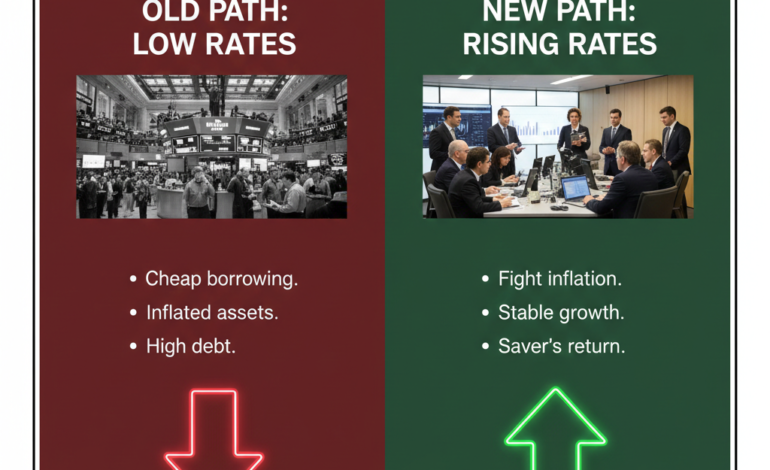
When the benchmark rate is low, borrowing becomes cheap. This encourages businesses to expand and consumers to buy homes or cars, generally stimulating economic activity. When the benchmark rate is high, borrowing becomes expensive. This cools down spending and investment, which is often necessary to prevent the economy from overheating and driving up prices (inflation).
Why 2026 Is a Turning Point for Global Interest Rates
The economic landscape of 2026 is defined by a delicate balancing act. Following the volatile inflationary periods of the early 2020s, many major economies have entered a new phase. The rapid rate hikes of previous years have largely done their job in curbing runaway price increases, but the full impact of those policies is still working its way through the system.
We are now seeing a shift from “crisis management” to “maintenance.” Central banks are no longer scrambling to catch up with soaring inflation figures. Instead, they are fine-tuning their approach to ensure that price stability remains permanent without causing a recession. This year represents a pivot point where policymakers must decide whether to hold rates steady, cut them to spur growth, or raise them slightly to address lingering inflationary pressures.
How Central Banks Control Interest Rates
Central banks do not simply announce a rate and hope for the best. They utilize specific monetary policy tools to manipulate the supply of money in the economy.
Monetary Policy Tools
The primary tool is the adjustment of the policy rate. By raising this rate, the central bank makes it more expensive for commercial banks to borrow reserves. Banks then pass these higher costs onto their customers in the form of higher interest rates on loans and credit cards.
Conversely, lowering the rate makes reserves cheaper, encouraging banks to lend more freely at lower rates. This transmission mechanism ensures that central bank decisions filter down to the real economy.
Quantitative Tightening and Liquidity
Beyond setting rates, central banks manage their balance sheets. During periods of economic distress, central banks often buy government bonds to inject cash (liquidity) into the system—a process known as Quantitative Easing (QE).
In 2026, many central banks are engaged in the opposite process: Quantitative Tightening (QT). This involves selling those bonds or letting them mature without replacing them. This action removes liquidity from the financial system, effectively tightening financial conditions even further than rate hikes alone would achieve. It is a secondary lever used to ensure the economy does not run too hot.
Major Central Banks Shaping Global Trends
While every country has its own monetary authority, a few key players set the tempo for the global economy.
- U.S. Federal Reserve (The Fed): As the central bank of the world’s largest economy and the issuer of the global reserve currency (the US Dollar), the Fed’s decisions have the furthest reach. A rate hike by the Fed attracts capital to the US, often strengthening the dollar and forcing other nations to adjust their own policies to compete.
- European Central Bank (ECB): Managing the euro area requires balancing the diverse economic needs of multiple nations, from industrial powerhouses like Germany to service-oriented economies in the south. The ECB’s moves dictate borrowing costs across the entire Eurozone.
- Bank of England (BoE): As a major financial hub, the UK’s monetary policy influences global banking and finance sectors significantly, even outside of Europe.
- Bank of Japan (BoJ): Historically known for keeping rates extremely low (or negative) to fight deflation, the BoJ’s shifts in 2026 are critical. Any move toward normalization in Japan impacts global bond markets, as Japanese investors are significant holders of foreign debt.
Impact of Interest Rate Shifts on the Economy
When rates change, the effects cascade through various sectors. This transmission is rarely instant; economists often say monetary policy works with “long and variable lags.”
Inflation and Consumer Prices
The primary goal of raising rates is to control inflation. High interest rates dampen demand. If it costs more to borrow money to build a factory or buy a house, fewer people do it. Reduced demand relieves pressure on supply chains and labor markets, eventually causing price increases to slow down.
In 2026, the focus remains on keeping inflation near the standard 2% target. If rates are lowered too quickly, inflation could flare up again. If they stay high for too long, they risk driving prices down too fast, leading to deflation, which can be just as damaging.
Employment and Economic Growth
There is a historical trade-off between fighting inflation and maintaining full employment. High interest rates can slow business expansion. When companies face higher debt servicing costs and reduced consumer demand, they may freeze hiring or lay off workers.
Central banks aim for a “soft landing”—cooling the economy enough to lower inflation without causing a spike in unemployment. In 2026, labor markets are being closely watched to see if high rates have begun to erode job growth significantly.
Currency Strength and Global Trade
Interest rates drive currency value. If Country A offers a 5% interest rate on government bonds and Country B offers only 2%, investors will move their money to Country A to get a better return. This demand strengthens Country A’s currency.
For 2026, this dynamic is crucial for global trade. A stronger currency makes imports cheaper (helping with inflation) but makes exports more expensive (hurting manufacturers). Central banks must consider how their rate decisions affect their nation’s competitiveness on the global stage.
How Interest Rates Affect Financial Markets
Financial markets act as a barometer for interest rate expectations. Traders and investors react instantly to central bank announcements, often before the policies affect the real economy.
Stock Market Reactions
Generally, higher interest rates are a headwind for stock prices. Higher borrowing costs eat into corporate profits. Furthermore, if investors can get a guaranteed “risk-free” return of 4% or 5% from government bonds, they may be less inclined to take risks on the stock market. This is particularly true for high-growth tech companies, whose valuations often depend on future earnings that look less attractive when discounted at higher interest rates.
Bond Yields and Fixed Income
Bond prices and interest rates move in opposite directions. When new bonds are issued with higher interest rates, existing bonds with lower rates become less valuable, causing their prices to drop. In 2026, investors in fixed income are navigating a market where yields are stabilizing, offering income opportunities that haven’t been available for over a decade.
Real Estate and Mortgage Rates
Perhaps the most direct link for the average person is the housing market. Mortgage rates typically track the yield on long-term government bonds, which are influenced by central bank expectations.
High rates increase the monthly cost of buying a home, which reduces demand and can cool off housing prices. In 2026, the real estate sector continues to adjust to this environment, with buyers and sellers calibrating their expectations away from the near-zero rates of the past.
Effects on Businesses and Borrowing Costs
For the corporate world, interest rates determine the hurdle rate for new projects.
Corporate Loans and Investment Decisions
When a company wants to build a new facility or acquire a competitor, it often finances the deal with debt. If interest rates are high, the return on investment (ROI) for that project must be even higher to justify the cost.
This dynamic can stifle innovation and expansion in the short term. However, it also enforces financial discipline, ensuring that capital flows only to the most efficient and profitable ventures, rather than speculative bubbles.
Small Business Financing
Small and medium-sized enterprises (SMEs) are often more sensitive to rate hikes than large corporations. While global giants may have cash reserves or fixed-rate bonds, small businesses often rely on variable-rate bank loans or lines of credit. As rates rise, their operating costs increase immediately, squeezing margins and potentially forcing consolidation in vulnerable industries.
Impact on Consumers Worldwide
Households feel the pinch (or the benefit) of interest rate policies in two distinct ways: as borrowers and as savers.
Credit Cards and Personal Loans
Most credit card rates are variable and pegged to the prime rate. When the central bank hikes rates, interest charges on credit card balances rise almost immediately. This reduces disposable income for families carrying debt, leading to lower consumer spending on non-essential goods.
Savings Accounts and Investment Returns
The silver lining of higher rates is the return on savings. For years, savers earned almost nothing on bank deposits. In the current 2026 environment, high-yield savings accounts and Certificates of Deposit (CDs) offer tangible returns. This shifts consumer behavior, encouraging saving over spending, which aids the central bank’s goal of cooling demand.
Global Spillover Effects of Rate Decisions
In a connected global economy, no central bank acts in a vacuum. Decisions made in major economies spill over into emerging